Português
 Español
50W RMS Class AB Amplifier using TIP35/TIP36 – Complete Project with PCB

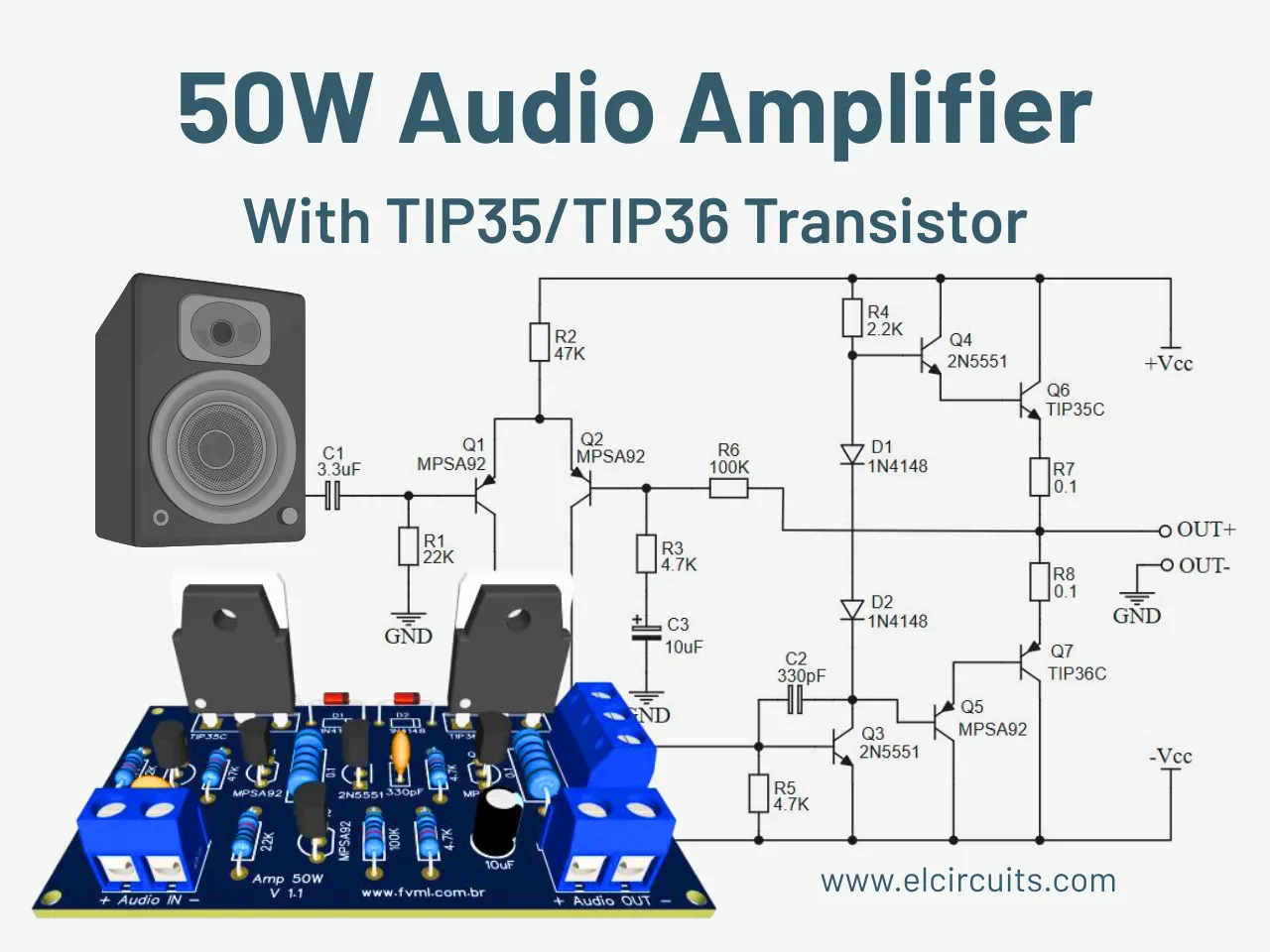
Looking for an amplifier that delivers power, sound quality, and is feasible to build at home? The answer lies in this classic topology that stands the test of time. In my over 15 years working with audio circuits, few projects have balanced simplicity and performance as well as this 50W RMS amplifier into an 8Ω load.
But that's not all. What makes this circuit special is its ability to deliver exceptional sound using components easily found on the market. Experience has shown me that projects like this are perfect for both beginner enthusiasts and veterans looking for a quick and reliable project.
Let's look at the facts: this amplifier uses an old but extremely efficient topology that continues to be a reference in many commercial projects to this day. Get ready to discover how to build this circuit step by step, understand its operation, and obtain the printed circuit board files for your assembly.
⚙️ Technical Characteristics of the Amplifier
This amplifier delivers 50W RMS of power into an 8Ω load with excellent signal-to-noise ratio and low harmonic distortion, all using a Class AB topology with a symmetrical ±35V power supply.
Here's the secret: the simplicity of the circuit does not compromise audio quality. On the contrary, experience has shown me that projects with fewer components, when well designed, often exhibit greater reliability and less signal interference.
- Power: 50W RMS into 8Ω load
- Topology: Class AB with low distortion
- Power Supply: Symmetrical ±35V
- Input Impedance: 22KΩ
- Output Transistors: TIP35C (NPN) and TIP36C (PNP)
- Components: Few elements, all easily available
- Frequency Response: 20Hz to 20kHz (±1dB)
To better understand the importance of Class AB, think of it as a perfect middle ground between Class A and Class B. While Class A offers excellent quality but with low efficiency, and Class B is efficient but suffers from crossover distortion, Class AB combines the best of both worlds: good sound quality with acceptable energy efficiency.
🔌 Circuit Schematic Diagram
The schematic diagram below shows the complete circuit of the 50W RMS amplifier, with all components properly identified and interconnected.
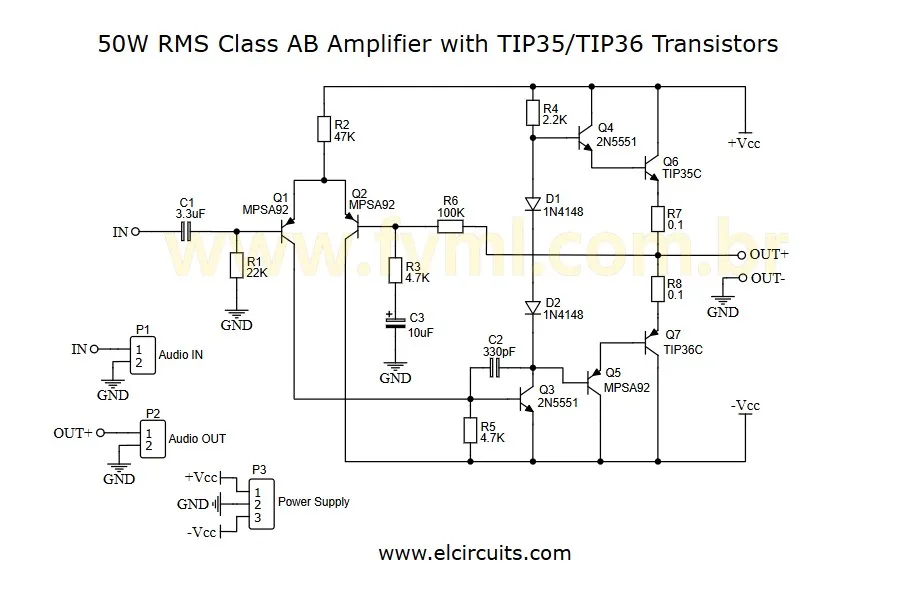
As we can observe, the circuit is divided into three main stages: input, driver, and output. Each plays a fundamental role in the final audio quality. Let's analyze each one in detail.
🛠️ Detailed Circuit Operation
The amplifier operates in three distinct stages that work together to amplify the audio signal with minimal distortion. Each stage was carefully designed to optimize the overall circuit performance.
Input Stage: Differential Amplifier
The input stage consists of transistors Q1 and Q2, which form a differential pair. This stage is responsible for the initial signal amplification and common-mode noise rejection.
Think of this stage as a "smart filter" that separates the desired signal from any unwanted interference. The MPSA92 transistors were chosen for their high gain capability and operating voltage (100V between collector and emitter), but can be replaced by BC558 without significant performance losses.
Capacitor C1 (3.3μF) is responsible for input signal coupling, while resistor R1 (22K) determines the input impedance. Together, they form an RC filter that attenuates very high frequencies, preventing instabilities in the circuit.
Driver Stage: Voltage Amplification
The second stage, known as the driver, consists of transistors Q4 and Q5. Its function is to provide additional voltage gain and prepare the signal for the output stage.
This stage works as a "bridge" between the low power of the input stage and the current requirements of the final stage. Components R3 and C3 form the decoupling network (or "destabilization") that ensures the stability of the differential amplifier and promotes proper signal flow.
Output Stage: Push-Pull Configuration
The final stage uses a complementary push-pull configuration with power transistors Q6 (TIP35C) and Q7 (TIP36C). This topology allows each transistor to conduct half of the signal, optimizing efficiency and minimizing distortion.
To understand how it works, imagine two workers on an assembly line: while one pushes the product (positive half-cycle), the other pulls (negative half-cycle), ensuring continuous and smooth movement. Similarly, the TIP35C and TIP36C transistors work together to faithfully reproduce the entire audio spectrum.
Resistors R7 and R8 (0.1Ω 3W) are fundamental for thermal stability and short-circuit protection, functioning as current sensors that help balance the operation of the output transistors.
If you don't have access to these specific transistors, we provide on our website a tool called Transistor BJT Equivalent By Data Cross-Reference, which can help you find compatible alternatives for your project.
🛠️ Complete Component List
To facilitate your assembly, we list all the components needed to build the amplifier. All are easily available and can be found in specialized or online stores.
Semiconductors
- Q1, Q2, Q5: PNP Transistor MPSA92
- Q3, Q4: NPN Transistor 2N5551
- Q6: NPN Transistor TIP35C
- Q7: PNP Transistor TIP36C
- D1, D2: 1N4148 Diodes
Resistors
- R1: 22K Resistor (red, red, orange)
- R2: 47K Resistor (yellow, violet, orange)
- R3, R5: 4.7K Resistor (yellow, violet, red)
- R4: 2.2K Resistor (red, red, red)
- R6: 100K Resistor (brown, black, yellow)
- R7, R8: 0.1Ω 3W Resistor (black, black, silver)
Capacitors
- C1: 3.3μF Electrolytic Capacitor
- C2: 330pF Ceramic Capacitor
- C3: 10μF Electrolytic Capacitor
Miscellaneous
- B1: 2-Pin Board-to-Cable Terminal Connector
- B2: 3-Pin Board-to-Cable Connector
- Miscellaneous: Printed Circuit Board, solder, wires, etc.
💡 Fresh Ideas for Your Next Project
Did you enjoy this project? Then you'll love exploring other circuits we've prepared. Each one with its unique features and ideal applications!
- How to Build a 50W RMS MOSFET Audio Amplifier - DIY Project
- 140W Class-AB Amplifier with MJL4281A / MJL4302A Transistors - With PCB
- 160W Hi-Fi Mosfet Amplifier with 2SK1058 / 2SJ162 Transistors + PCB
- Mini Powerful Audio Amplifier: Only 5 Transistors + PCB
- 440W Class-AB Mosfet Power Amplifier with IRFP9240 / IRFP240 + PCB
- Simple 3-Transistor Power Amplifier for 600W RMS Subwoofer + PCB
🖨️ Printed Circuit Board (PCB)
To facilitate your assembly, we provide the Printed Circuit Board (PCB) files designed specifically for this amplifier. The PCB was carefully planned to minimize interference and ensure maximum signal quality.
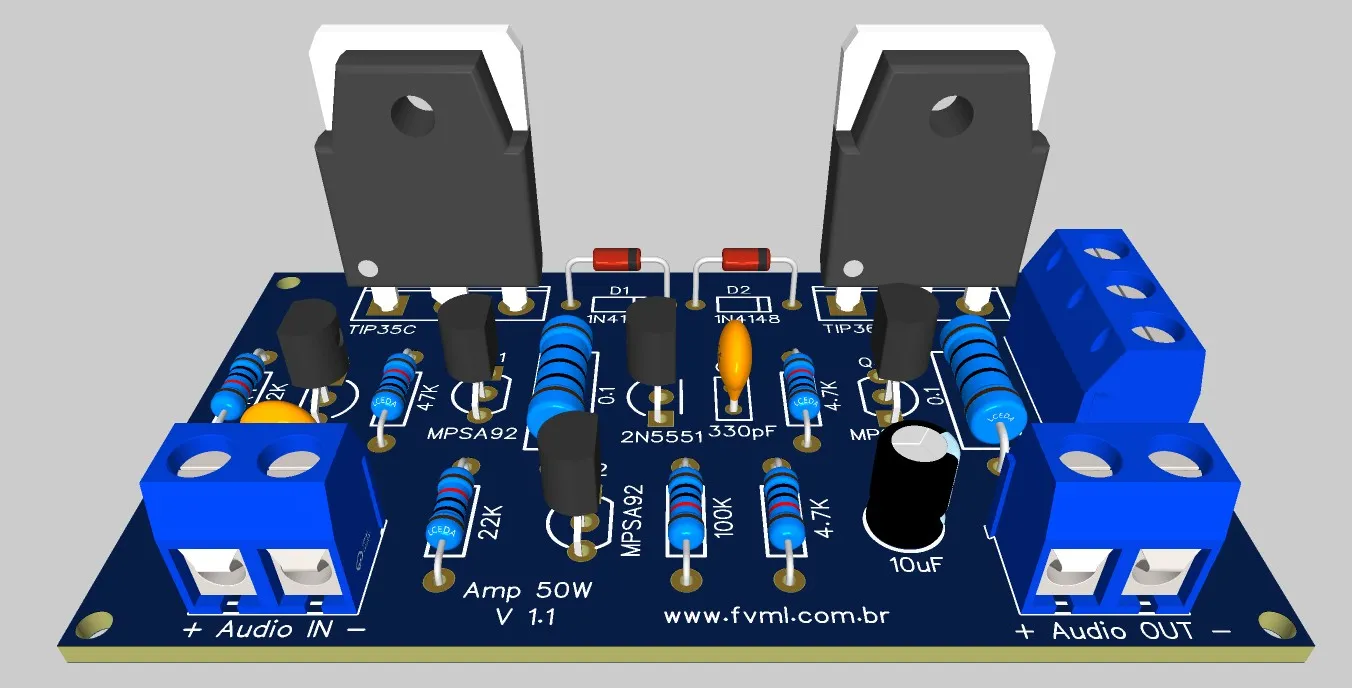
The files are available in GERBER, PDF, and PNG formats, covering all your needs, whether for home assembly or to send to professional manufacturing. The PCB layout follows the best practices in audio circuit design, with properly dimensioned traces and strategic component placement.
📥 Direct Download Link
To download the necessary files to assemble the electronic circuit, simply click on the direct link provided below:
🤔 Frequently Asked Questions (FAQ)
To ensure your project is a success, we've compiled some of the most common questions about this amplifier. Check it out!
What is the difference between RMS power and peak power? 🔽
RMS (Root Mean Square) power represents the continuous power that the amplifier can deliver without distortion, while peak power is the maximum the amplifier can deliver in brief moments. This amplifier delivers 50W RMS, which means it can provide 50 watts continuously and stably, making it ideal for prolonged use without risk of damage to components or audio distortion.
Can I use this amplifier with 4Ω speakers? 🔽
Yes, but with some precautions. When using 4Ω speakers, the power will increase significantly (close to 80-90W RMS), but the stress on the output transistors and heat dissipation will also increase. It is essential to ensure that the TIP35C/TIP36C transistors are mounted on adequate heat sinks and that the power supply can deliver the necessary current without overheating.
What are the advantages of Class AB topology? 🔽
Class AB topology combines the best characteristics of Class A and Class B. It offers greater energy efficiency than Class A (less heat dissipation) and better sound quality than Class B (less crossover distortion). This results in an amplifier with a good signal-to-noise ratio, low harmonic distortion, and acceptable efficiency, making it ideal for high-fidelity audio applications where sound quality is important.
✨ Conclusion
This 50W RMS Class AB amplifier represents the perfect balance between simplicity and performance. With easily available components and a time-tested design, it offers an excellent option for those seeking sound quality without excessive complexity.
Experience has shown me that projects like this are the most rewarding: they work reliably, are easy to build, and deliver professional results. Whether you're a beginner taking your first steps in the audio world or a veteran looking for a quick and efficient project, this amplifier will certainly meet your expectations.
Now it's your turn! Download the PCB files, gather the components, and start your assembly. Don't forget to share your results and questions in the comments below. Your experience can help other enthusiasts with their projects!
✨ Our Gratitude and Next Steps
We sincerely hope this guide has been useful and enriching for your projects! Thank you for dedicating your time to this content.
Your Feedback is Invaluable:
Have any questions, suggestions, or corrections? Feel free to share them in the comments below! Your contribution helps us refine this content for the entire ElCircuits community.
If you found this guide helpful, share the knowledge!
🔗 Share This GuideBest regards,
The ElCircuits Team ⚡