Português
 Español
DIY 70W TDA7294 Hi-Fi Amplifier with 3-Band EQ + PCB Design

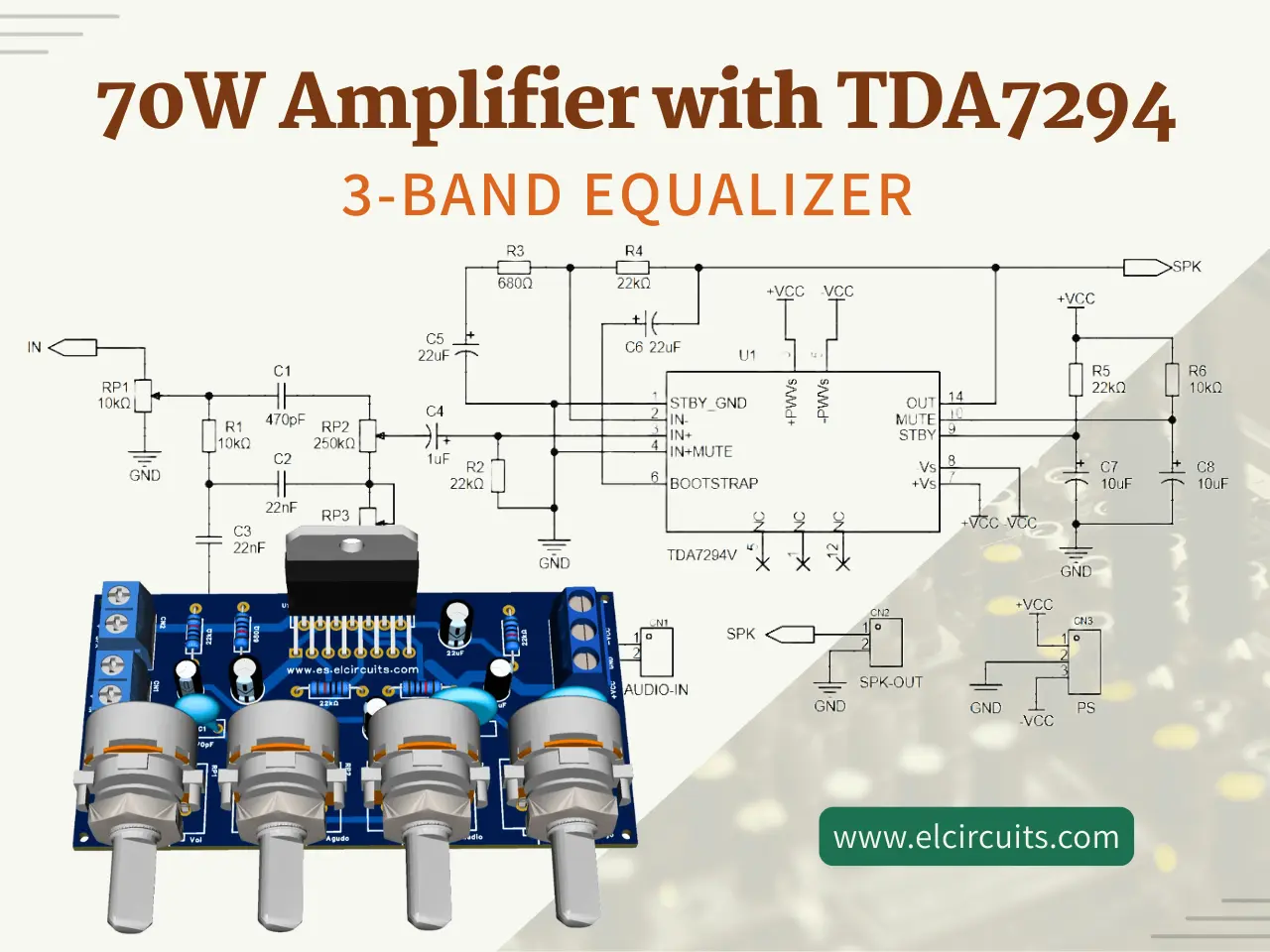
The Definitive Guide to the 70W TDA7294 Hi-Fi Amplifier with 3-Band Equalizer + PCB: High Fidelity Audio in Practice
If you have ever dreamed of building your own sound system that rivals professional equipment, but without the complexity of indecipherable industrial diagrams, you are in the right place. There is a component that is a living legend among audio DIYers (Do It Yourselfers): the TDA7294.
Imagine having in your hands not just an amplifier, but a sound control center capable of delivering 70 Watts of crystal-clear power with human warmth and preserved musical nuances.
In this article, we won't just connect wires; we will dissect the physics, the electronics, and the art of designing a complete Hi-Fi amplifier, equipped with a 3-band equalizer for fine-tuning bass, mids, and highs, and all of this supported by a professional PCB (Printed Circuit Board) project.
Get ready to understand the "why" of each component, how to avoid the deadly hum, and how to assemble equipment that will make your workbench proud. Shall we start?
💚 The Heart of the Project: What is the TDA7294?
BLUF: The TDA7294 is a high-power and high-fidelity analog audio amplifier chip, designed to act as a robust "engine" for speakers.
To understand the genius of this component, let's use a mechanical analogy. If common operational amplifiers were small toy motors, the TDA7294 would be a racing V8 engine.
The TDA7294 is a monolithic integrated circuit from STMicroelectronics that combines the precision of a power MOSFET circuit with the thermal protection of a modern system. Unlike old bipolar chips (like the LM3886 or TDA2050, which are also excellent but have distinct characteristics), the TDA7294 uses DMOS technology in the output stage.
Here is the crucial part: the DMOS output offers an extremely musical sound response, with harmonic distortion that many listeners consider "pleasant" to the human ear, in addition to a capacity to deliver very high peak currents to capture music transients (like the hit of a kick drum or the attack of a piano).
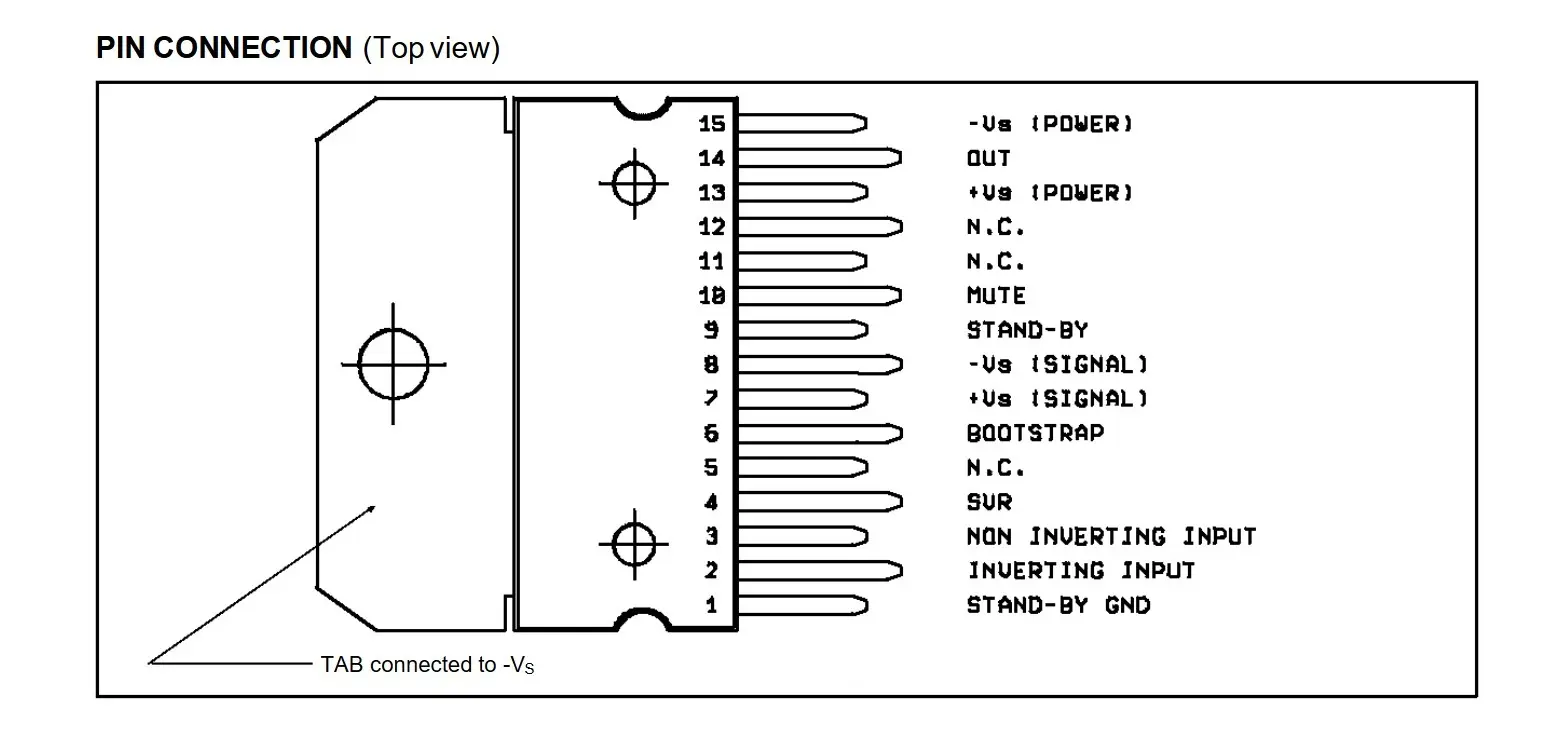
Key Technical Specifications
In bench practice, what do these numbers mean for your sound?
| Parameter | Typical Value | Practical Implication |
|---|---|---|
| Supply Voltage | ± 10V to ± 40V | Flexibility to use symmetrical power supplies from 24V up to 80V toroidal transformers. |
| Output Power | 70W (RMS) | Enough volume for living rooms or small studios. |
| Distortion (THD) | 0.005% | Clean audio, without that "hiss" or distortion at maximum volume. |
| Protections | Thermal, Short, Overvoltage | Safety to burn fewer chips in assembly errors. |
🔊 The Soul of Sound: 3-Band Equalizer
BLUF (Bottom Line Up Front): The equalizer allows shaping the audio frequency response, correcting room acoustic flaws or personal listening preferences.
A pure power amplifier (like the TDA7294 alone) is linear: it increases the volume without altering the "character" of the sound. However, real environments are not perfect. Your sofa absorbs highs, your corner amplifies bass.
A 3-band equalizer (Bass, Mid, Treble) is inserted in the audio input stage. The classic architecture used here is based on a low-noise passive circuit. The secret here is not just adding control, but adding control without adding noise.
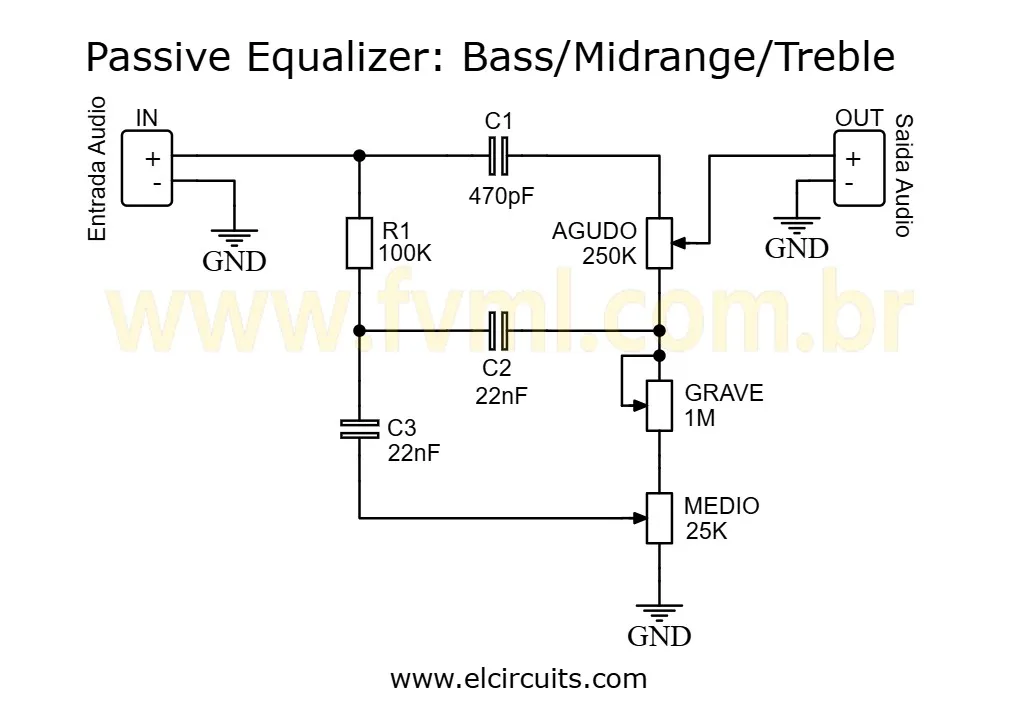
Anatomy of the Bands
- 🔊 Bass: Generally centered around 100Hz. Controls the "punch" of the sound. Too powerful and the sound gets "muddy"; too little, and the sound becomes thin.
- 🎸 Mid: The critical range (approx. 1kHz to 3kHz) where the majority of human voice frequencies and solo instruments reside. Adjusting here brings the vocal forward or pushes it back.
- 🔔 Treble: Above 10kHz. Gives the "shine" and definition (the "air" of the cymbals). Be careful with excess to cause listening fatigue.
-
🔌 Complete Amplifier Circuit Schematic Diagram
The complete schematic diagram of our 70W amplifier with passive 3-band equalizer is laid out in Figure 4 below. As you can observe, it is a circuit elegant in its simplicity but powerful in its functionality. The arrangement of components was carefully designed to ensure a smooth frequency response and intuitive controls for maximum power.
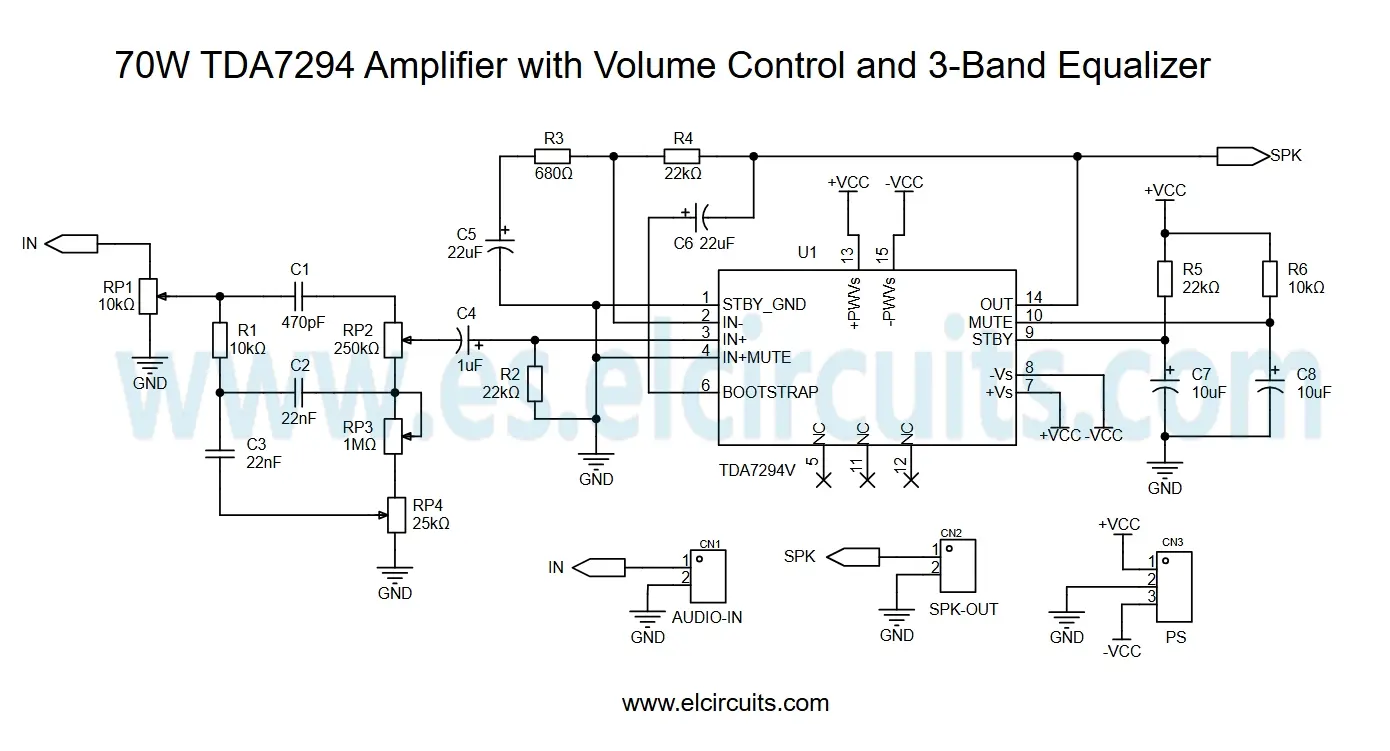
🧾 Bill of Materials (BOM) - TDA7294 70W Amplifier
| Reference | Component / Value | Description |
|---|---|---|
| U1 | TDA7294V | Audio Amplifier IC |
| RP1 | 10kΩ | Volume Potentiometer |
| RP2 | 250kΩ | Treble Control |
| RP3 | 1MΩ | Mid Control |
| RP4 | 25kΩ | Bass Control |
| R1, R6 | 10kΩ | 1/4W Resistors |
| R2, R4, R5 | 22kΩ | 1/4W Resistors |
| R3 | 680Ω | 1/4W Resistor |
| C1 | 470pF | Ceramic |
| C2, C3 | 22nF | Polyester |
| C4 | 1µF / 25V | Electrolytic or Polyester |
| C5, C6 | 22µF / 50V | Electrolytic |
| C7, C8 | 10µF / 50V | Electrolytic (X4 units - see note*) |
| CN1, CN2 | KRE 2 pins | Input and Output |
| CN3 | KRE 3 pins | Power Supply (+35V GND -35V) |
🖨️ The Secret of Hi-Fi: The Printed Circuit Board (PCB) Design
BLUF: Even the best electrical schematic will fail if the PCB layout is poorly designed, as electromagnetic interference and poor ground management will create noise.
Many beginners underestimate the board design. In high-power audio, the printed circuit board is not just a support for components; it is part of the circuit. Here is what differentiates a professional PCB from an amateur one:
1. Ground Routing
Imagine electricity as water in pipes. If you throw dirty water (current return from the speaker) into the same pipe as clean water (pre signal), you get mud in the signal. In audio, this is hum.
The PCB must use a Star Ground. The input signal ground, the filter ground, and the power ground must meet at a single point. Ground tracks should be wide (fat traces) to minimize resistance.
2. Power Tracks
The tracks that carry the power supply (+Vcc and -Vee) to the TDA7294 pin must be short and wide. This avoids voltage drops and improves the response to deep bass transients.
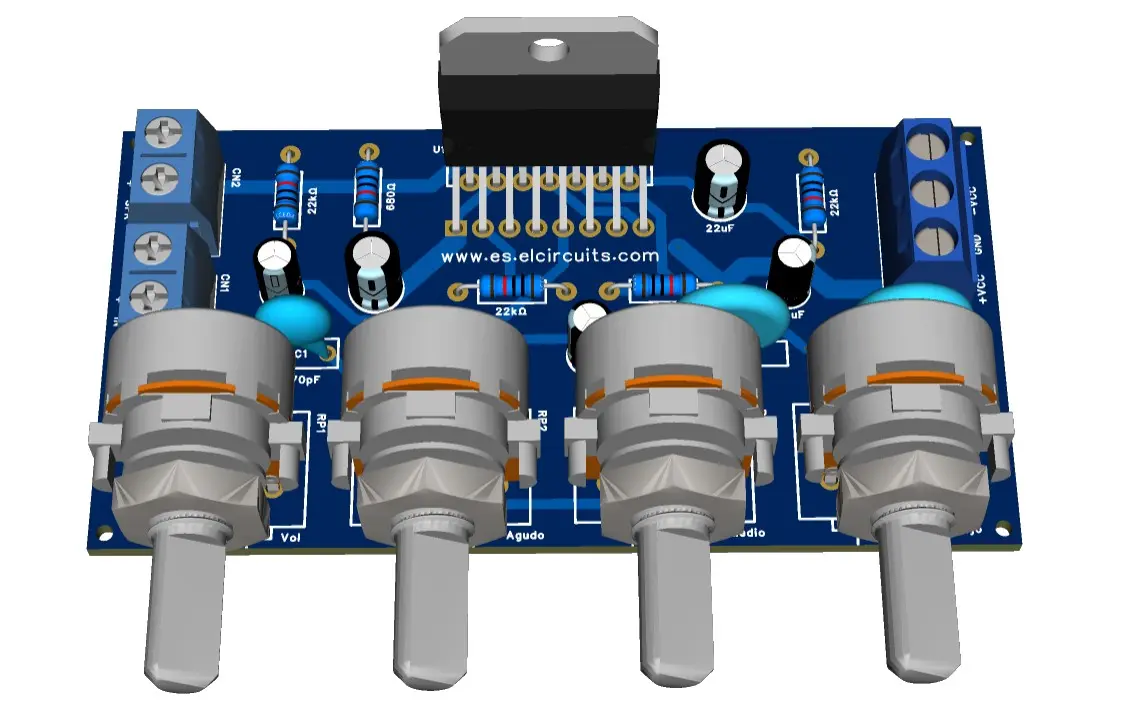
3. Decoupling and Stabilization
The TDA7294 requires a 100µF (or larger) capacitor as close as possible to its power supply pins. This serves as a local "energy tank" for the chip to pull from during a strong bass hit, preventing the supply from fluctuating and causing distortion.
⚠️ Care on the Workbench: Offset Adjustment
Before connecting the speaker, turn on the amplifier and measure the DC voltage at the TDA7294 output pins with respect to ground. It should be very close to 0V (a few millivolts). If there is DC voltage (e.g., 2V or more), turn off immediately and check your wires or the soldering of the components. DC voltage burns speakers instantly.
🎶 Real Applications and Final Considerations
This project is not just a theoretical exercise. With 70 real Watts per channel, you can power:
- Studio speakers (8 Ohm passive monitors).
- High-performance Home Theater systems.
- Guitars and Basses (with Equalizer adjustment for the instrument).
But there is more: The inclusion of Mute and Stand-by (pins 9 and 10 of the TDA7294) is an engineering touch that many amateurs ignore. Controlling these pins with a small timer circuit or simple switches ensures there is no loud "pop" when turning the amplifier on, preserving your speakers and your ears.
The key point is this: By combining the robustness of the TDA7294 with the tonal versatility of the passive equalizer and a well-thought-out PCB, you create a system that respects the music. You are not just amplifying electrical waves; you are delivering the emotion of the original recording.
🤔 Frequently Asked Questions (FAQ)
To ensure your project is a success, we have compiled some of the most common questions on this topic. Check it out!
Can I use a computer power supply (ATX) for this
amplifier?
🔽
Yes, it is possible, but with caveats. An ATX power supply provides +12V. The TDA7294 works with 12V, but the power will drop drastically (to about 10W to 15W at 4 Ohms). To reach the nominal 70W, you need a symmetrical (split rail) power supply of at least ±35V (toroidal transformer). Use the ATX only for initial tests or low-power setups.
What is the difference between using the TL072 and the NE5532 in the
equalizer stage?
🔽
The TL072 is a low-noise FET, excellent for guitar (high-gain) due to its high input impedance. However, for high-fidelity Hi-Fi audio, the NE5532 is preferred. It is "faster" (higher slew rate) and has lower total harmonic distortion in the audio range, resulting in a cleaner and more transparent sound for critical listening.
Why is my amplifier hissing or humming even without music?
🔽
This is usually a "Ground Loop" or poor shielding problem. Check if the shield of the input cables is connected correctly at only one end. On the PCB, ensure that the signal ground (input) is separated from the power ground (speaker return) until they meet at the main ground terminal (Star Ground).
🎓 Conclusion: Your Journey into Pure Audio
Building a 70W TDA7294 Hi-Fi Amplifier with 3-Band Equalizer is a project that combines the best of classic audio engineering with modern practicality. You learned that the TDA7294 is a robust giant, the equalizer is the maestro of the sound, and the PCB is the foundation that supports the quality.
Don't be afraid to solder, make mistakes, and adjust. Experience on the workbench is what separates the theorist from the true master of electronics. Now that you have the technical knowledge, the conceptual schematic, and best practices, it's time to pick up the soldering iron and bring your sound to life.
Do you already have experience with the TDA7294 or want to share your PCB layout? Leave a comment below and let's debate audio!
✨ Our Gratitude and Next Steps
We sincerely hope this guide has been useful and enriching for your projects! Thank you for dedicating your time to this content.
Your Feedback is Invaluable:
Have any questions, suggestions, or corrections? Feel free to share them in the comments below! Your contribution helps us refine this content for the entire ElCircuits community.
If you found this guide helpful, share the knowledge!
🔗 Share This GuideBest regards,
The ElCircuits Team ⚡