Português
 Español
Pro Symmetric PSU for 2500W Amp: PCB Layout & Calc Guide

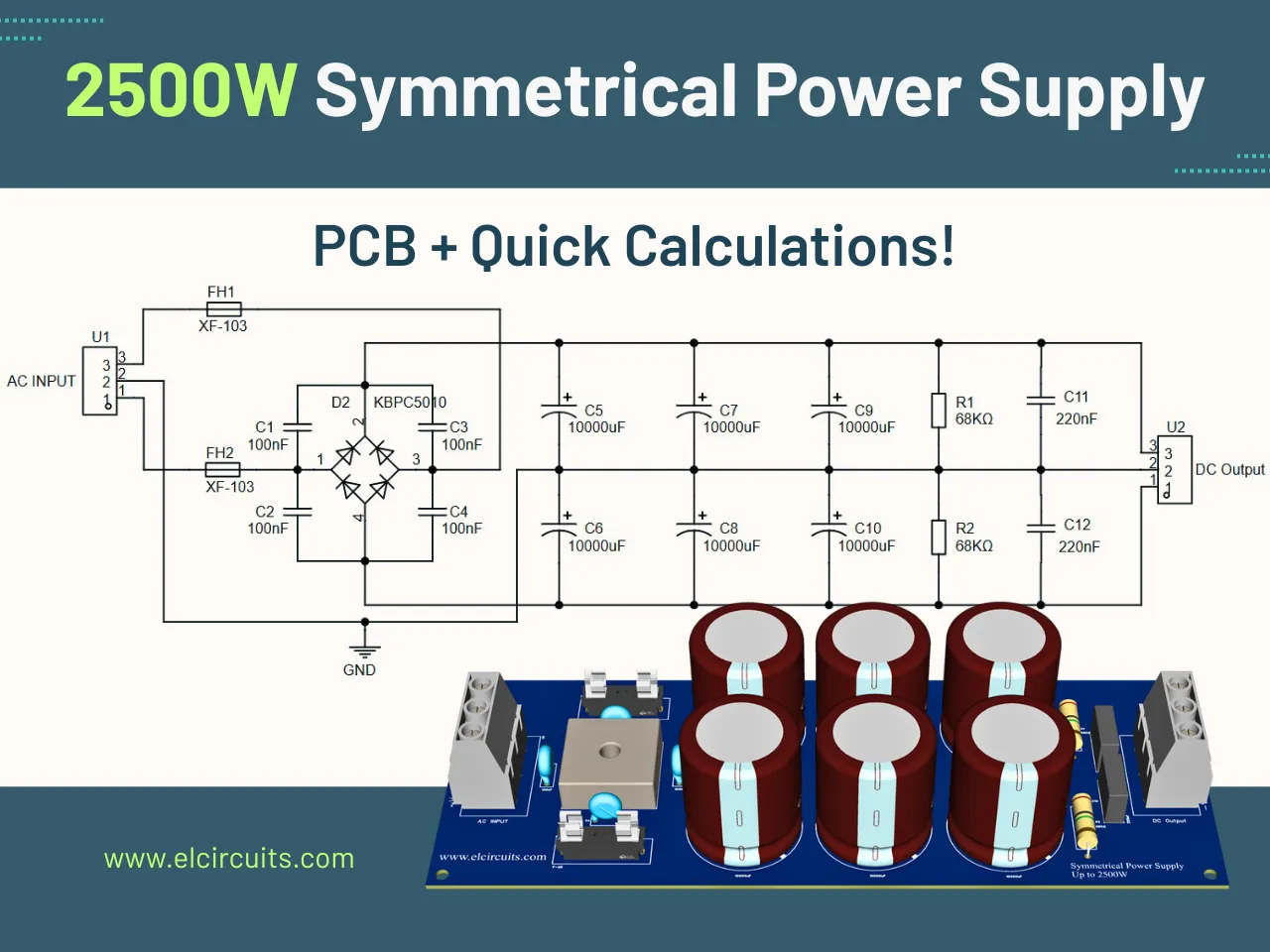
For high-fidelity audio lovers who build their own equipment, there is an undeniable truth: sound quality starts with the power supply. There is no point in having the best output stage or the most expensive transistors on the market if the system’s “power” is not up to par.
Today, we will dive deep into the design of a robust Symmetrical Power Supply, capable of powering amplifiers of up to 2500W of power with crystal stability. If you are a technician, engineering student, or an advanced hobbyist, get ready, because we will dissect every component, every formula, and every detail so you can build the benchmark on your workbench.
What Is a Symmetrical Power Supply and Why Is It Crucial?
Most high-performance audio amplifiers use a symmetrical circuit (also called a dual rail or split supply). Simply put, this means we have three power rails: +Vcc, –Vcc and GND (0V).
What’s the magic of this? Imagine a pendulum. It oscillates up and down around a central point (zero). A symmetrical power supply allows the audio signal (which is an alternating wave) to be “pushed” to the positive and “pulled” to the negative efficiently, without the need for a large coupling capacitor at the output, which preserves bass quality and frequency response.
Here, the focus is a linear power supply with full-wave rectification. Unlike switched power supplies (SMPS), linear ones offer less electrical noise (Ripple) and faster response to the transient demands of music, that is, when a bass drum kick explodes, the power supply delivers energy instantly without “locking up.”
Analysis of the Electrical Schematic
The beauty of this project lies in its simplicity allied with efficiency. The complete schematic, illustrated in Figure 2, shows the classic arrangement of center-tap transformer, bridge rectifier, and capacitor bank. But don’t be fooled by the simplicity; the stability of this circuit is responsible for the “clean” sound we seek.
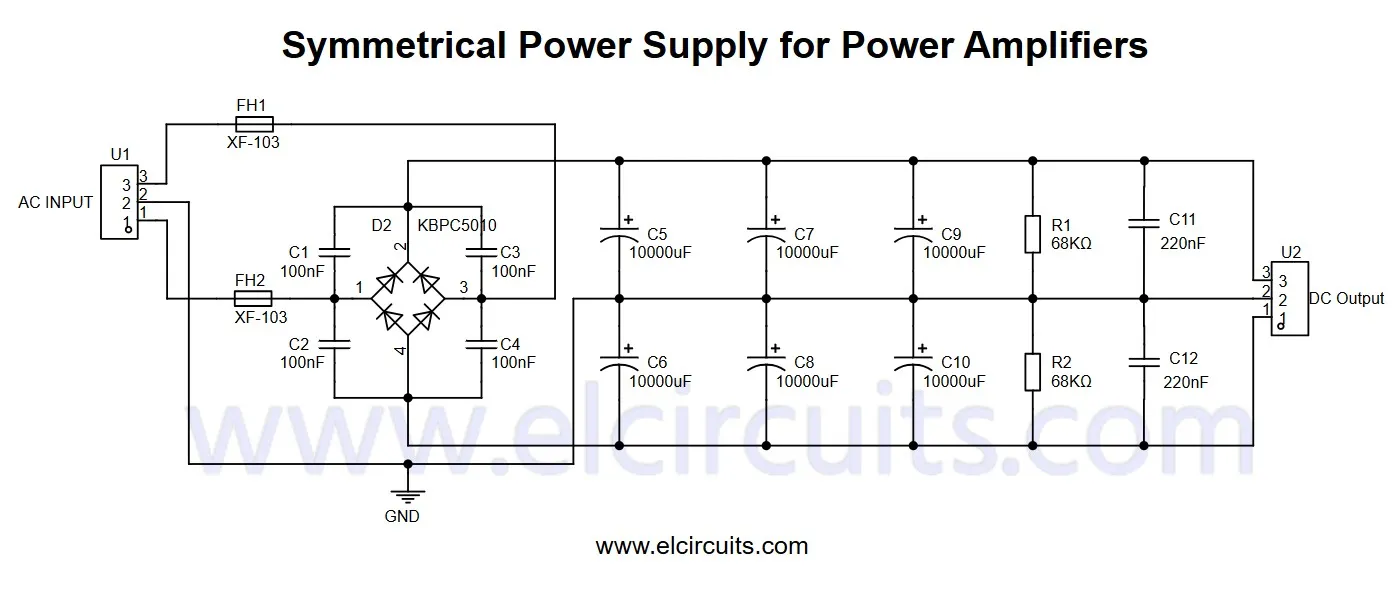
However, the true “secret” is not just in the diagram, but in how you calculate and choose components for the desired power. Copying the circuit is easy; sizing the correct values is what separates the amateur from the professional. Let’s analyze three practical configurations for different power ranges.
Calculation and Sizing: The Mathematics Behind Power
To size a power supply, we need to solve an equation with three variables: Voltage (V), Current (I) and Filtration (Capacitance). The goal is to ensure that voltage does not drop (sag) during music peaks and that ripple noise is kept under control.
Below, I prepared three real configurations based on Ohm’s Law (P = V x I) and capacitive filter calculation. For ripple calculations, we will consider a maximum tolerance of 5% over the supply voltage. This is the “sweet spot” that balances cost and performance.
Configuration 1: Amplifiers up to 400W
The Challenge: Design a power supply with 45V voltage capable of sustaining 400W.
First, we find the necessary current:
- Formula: I = P / V
- Calculation: I = 400 / 45
- Result: 8.88A
Now, let’s define how much ripple we accept. In this case, 5% of 45V
- Formula: V_ripple = V_source x 5\%
- Calculation: V_ripple = 45 x 0.05
- Result: 2.25V
Now, the critical part: the capacitor. The capacitor filter formula is C = I / (F x V_ripple). Where F is the ripple frequency after rectification. In 60Hz grids, the frequency will double to 120Hz (Full Wave).
- Calculation: C = 8.88 / (120 x 2.25)
- Calculation: C = 8.88 / 270
- Total Result: 0.032 F (approx 32.888 uF)
Educational note: The project predicts the use of 6 capacitors in the filter bank. To distribute the load evenly and increase lifespan, we divide the total value by 6.
- Individual Calculation: C_ind = 32.888 / 6
- Result per capacitor: 5.481uF
Practical Recommendation: For commercial values, we always round up to guarantee a safety margin. Use 6 capacitors of 6.800uF. (observing the amplifier voltage of 45V, use 63V capacitors).
Configuration 2: Amplifiers up to 1200W
The Challenge: Increase the class to 1200W with a voltage of 75V.
- Current: I = 1200 / 75 = 16A
Keeping ripple at 5%:
- Ripple Voltage: 75 x 0.05 = 3.75V
Capacitor calculation:
- Calculation: C = 16 / (120 x 3.75)
- Calculation: C = 16 / 450
- Total Result: 0.035 F (approx 35.555uF)
- Individual Calculation (per 6 caps): 35.555 / 6 = 5.925uF
Practical Recommendation: Here, the math is very similar to the previous one, but the working voltage of the capacitors must be higher. Use 6 capacitors of 6.800uF (observing the amplifier voltage of 75V, use 100V capacitors).
Configuration 3: The 2500W Monster
The Challenge: Extreme power. 2500W at 95V. Here, stability is everything.
- Current: I = 2500 / 95 = 26.31A (Rounding to 26A)
Allowed ripple (5%):
- Ripple Voltage: 95 x 0.05 = 4.75V
Capacitor calculation for high current:
- Calculation: C = 26 / (120 x 4.75)
- Calculation: C = 26 / 570
- Total Result: 0.045 F (approx 45.614 uF)
- Individual Calculation: 45.614 / 6 = 7.602 uF
Practical Recommendation: To withstand this brutal demand, we need robustness. Use 6 capacitors of 10.000 uF each. This guarantees a massive energy reserve for the deepest basses. (observing the amplifier voltage of 95V, use 120V capacitors).
PCB Layout and Assembly Suggestions
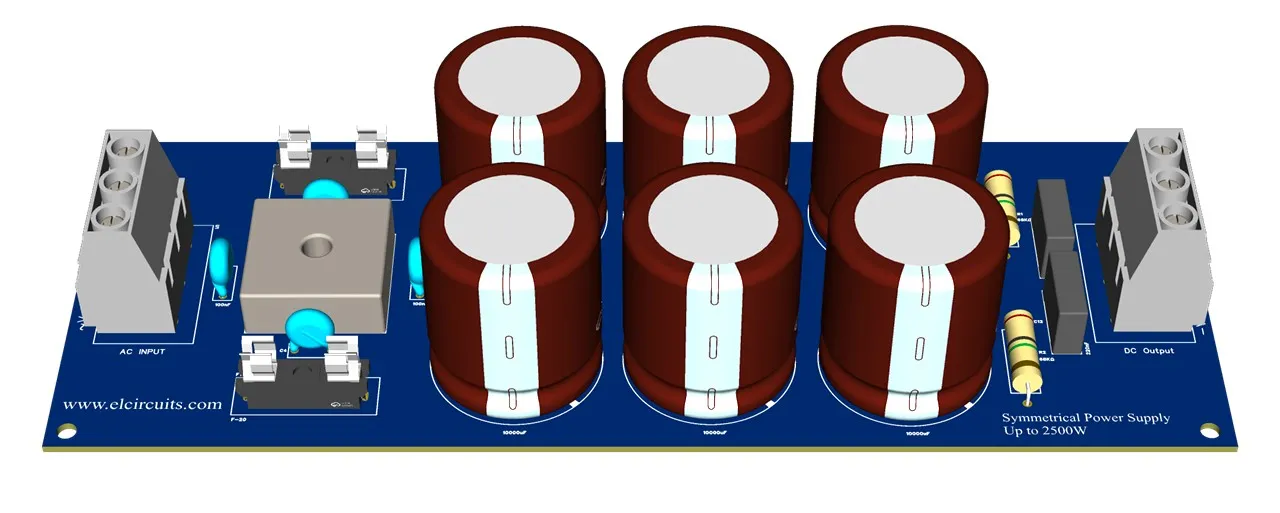
The printed circuit board (PCB) layout was designed to accommodate the bank of 6 capacitors symmetrically. When assembling, remember:
- Current Traces: The traces conducting the main current should be tinned to avoid heating and voltage drop.
- Rectification: Use original bridge rectifiers, this ensures that you will use your amplifier and will not overheat your diode bridge excessively. Use a heat sink for the bridge, in case of use with continuous 2500W.
- Grounding: Keep the central ground (star ground) well defined to avoid ground loops, which are the cause of humming (hum) in audio.
🤔 Frequent Questions (FAQ)
To ensure your project is a success, we have compiled some of the most common questions on this topic. Check it out!
Can I use capacitors with different values than the calculated ones? 🔽
Yes. The calculated values are the ideal minimum to guarantee the 5% ripple filtration. You can use capacitors of higher value (uF) without problems; this generally improves bass response. However, avoid using much smaller values, as this will increase the noise at the amplifier output.
Why does the capacitance formula use 120Hz? 🔽
The 120Hz frequency is based on the 60Hz electrical grid (common in Brazil and the USA). When using a full-wave rectifier, the ripple frequency doubles, going from 60Hz to 120Hz. If you are in a country with a 50Hz grid (like parts of Europe), replace 120 with 100 in the formula to get the correct result.
What capacitor voltage should I choose? 🔽
The capacitor’s isolation voltage (voltage written on its body) must always be higher than the power supply’s working voltage. For example, for a 75V power supply, use capacitors of at least 100V or 125V. Never use a 63V capacitor in a 75V power supply, as it will burst.
🖨️ Printed Circuit Board (PCB)
To make your life easier, in Figure 4, we provide the PCB files – Printed Circuit Board. The files are in GERBER, PDF, and PNG formats, covering all your needs, whether for a homemade assembly or to send to professional manufacturing.
And the best of all: the files are available for free download directly from the MEGA server, through a direct link, without any complication or redirection!
📥 File Package (PCB, GERBER, PDF)
Click the button below to download directly from MEGA:
DOWNLOAD COMPLETE FILES🎓 Conclusion
Designing a symmetrical power supply is exercising the perfect balance between electrical theory and workshop practice. Whether for a 400W amplifier for your car or 2500W for a professional PA system, the fundamentals presented here, Ohm’s Law, ripple filtration, and correct component specification, are the pillars that will ensure your equipment not only works but sounds exceptionally well.
✨ Our Gratitude and Next Steps
We sincerely hope this guide has been useful and enriching for your projects! Thank you for dedicating your time to this content.
Your Feedback is Invaluable:
Have any questions, suggestions, or corrections? Feel free to share them in the comments below! Your contribution helps us refine this content for the entire ElCircuits community.
If you found this guide helpful, share the knowledge!
🔗 Share This GuideBest regards,
The Electronic Circuits Team ⚡