Português
 Español
4-Channel Audio Mixer with LM3900 (Full Project + PCB Layout)

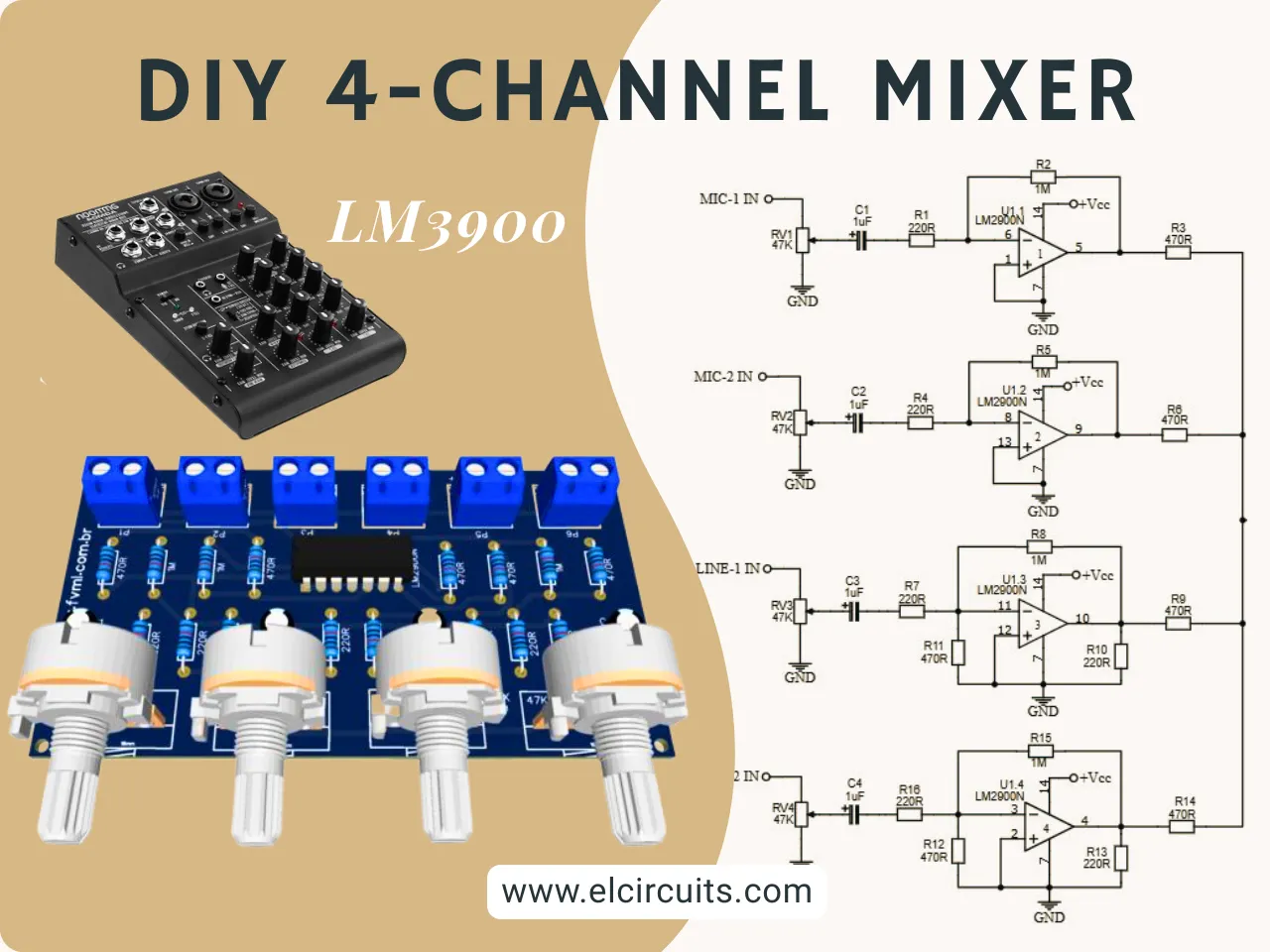
Hello Everyone!
Today, we're going to embark on a fascinating project: we'll build an audio mixer circuit, functioning as a sound mixer with 4 independent channels, using the integrated circuit LM3900 - a four-channel amplifier with independent channels.
This project is perfect for electronics students, musicians, audio technicians, and hobbyists who want to understand how an audio mixer works or need a practical and economical solution for small events, home studios, or presentations.
The circuit consists of two inputs for using microphones, with high impedance, and two inputs for musical instruments. But the best of all: the number of channels can be easily expanded!
Expert tip: The number of channels can be doubled or even tripled, requiring only to assemble two or three identical circuits and make the association of them. Imagine the possibilities!
Each channel has its own amplifier, with amplified inputs separately, making a sound mixer system almost professional, but with a very accessible cost.
📺 Visual Summary: View the Web Story for this 4-Channel Audio Mixer with LM3900
🎵 Practical Applications for your DIY Sound Mixer
The Sound Mixer Circuit, "MIX", or Audio Mixer, can be used in various projects. Below are some usage suggestions:
- 🎤 Input Controller for Microphones and Musical Instruments
- 📱 Player Controller, such as MP3, Smartphones, Records
- ⛪ In small churches that don't have a Sound Mixer
- 🎧 Home Studio for home recordings
- 🎸 Small shows and acoustic presentations
- 🎓 School projects and science fairs
Practical Example: Setup for Solo Musician
Imagine you're a singer and guitarist who performs in small venues. With this DIY sound mixer, you can:
- Connect your microphone to Channel 1
- Connect your guitar with pickup to Channel 2
- Connect your phone with backing tracks to Channel 3
- Keep Channel 4 as a reserve for a special guest
All this with individual volume control for each audio source!
🔧 The Heart of the Circuit: The LM3900 IC
The LM3900 IC is an integrated circuit composed of four independent operational amplifiers of the NORTON type (Current Differential Amplifiers), high frequency and gain compensated. They were manufactured specifically to operate from a single package, with a good range of supply voltages 4.5V to 32V.
Despite having 4 operational amplifiers, it's possible to operate only one or two, or three channels without any problems. The current consumption of the amplifier is quite low, and it can also be used with independent batteries for power - perfect for portable setups!
Technical Characteristics
| Characteristic | Specification |
|---|---|
| Supply range | 4.5V to 32V |
| Power supply type | Works with single or symmetrical supply |
| Bandwidth | Wide |
| Output voltage swing | Large |
| Protection | Against Short-Circuit at Output |
| Compensation | Internal frequency compensation |
| Input current | Low Input Bias Current |
| Compatibility | National Semiconductor LM2900 and LM3900 |
💡 Did you know?
The LM3900 is a Norton type amplifier, which operates with current instead of voltage at the input. This makes it particularly useful in audio applications where we need to mix multiple signals without interference between them.
🔍 How the Circuit Works
To mix audio signals from different and independent inputs, it is necessary to have a separator circuit for amplifying these independent channels. Since the LM3900 IC is a quadruple operational amplifier, we use its individual operational amplifiers for each channel to operate our MIX.
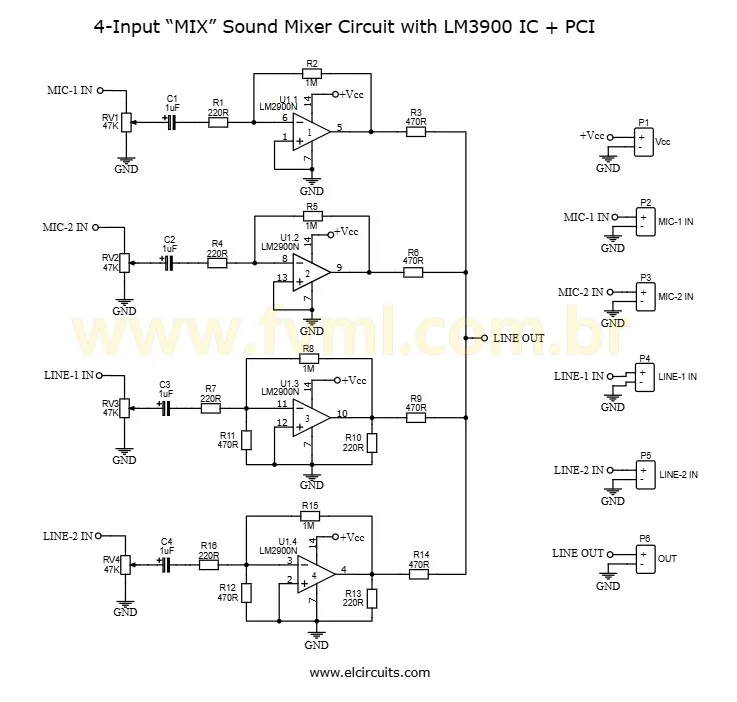
Each audio input is controlled through a potentiometer (RV1 to RV4) to control the gain of each operational amplifier. This allows individually adjusting the volume of each audio source before the final mix.
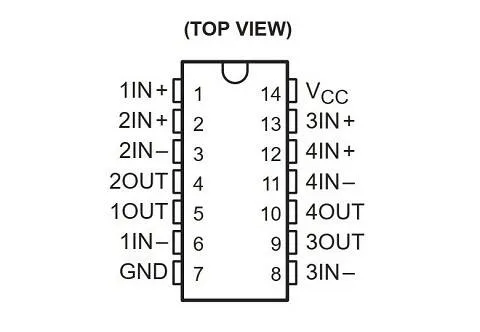
The LM3900 is compatible with the LM2900, the difference is the temperature range that each one supports. Both have 14 pins, as shown in Figure 2 below, and can be used without any problems in this circuit.
The capacitors are used to decouple the input signal of the MIX, and each channel has a decoupling capacitor. This ensures that there is no interference between channels and that the audio signal maintains its quality.
🎓 Teacher's Tip
The decoupling capacitors (C1 to C4) function as "gatekeepers" for each audio channel. They allow only the alternating audio signal to pass, blocking any direct current component that could cause noise or distortion in your mixer.
🔌 Circuit Schematic Diagram
In Figure 3 we have the schematic diagram of the Sound Mixer Circuit "MIX" of 4 Inputs with LM3900 IC. It's a quite simple circuit, however, be careful not to invert the Integrated Circuit, as you could damage it if you do.
⚠️ Attention!
When assembling the circuit, carefully check the pinout of the LM3900 IC. An incorrect connection can permanently damage the component. Always use a socket for the IC, this facilitates replacement in case of problems and protects the component during soldering.
💡 Fresh Ideas for Your Next Project
Did you enjoy this project? Then you'll love exploring other circuits we've prepared. Each one with its unique features and ideal applications!
🧩 Component List
- Semiconductor
-
U1 ................. LM3900 Integrated Circuit
- Resistors
- R1, R4, R7, R10, R13, R16 .... 220R 1/4W Resistor (red, red, brown, gold)
- R2, R5, R8, R15 ..................... 1M 1/4W Resistor (brown, green, black, gold)
- R3, R6, R9, R11, R12, R14 .... 470R 1/4W Resistor (yellow, violet, brown, gold)
-
RV1, RV2, RV3, RV4 ............. 47K Potentiometer
- Capacitors
-
C1, C2, C3, C4 ....... 1uF / 16V Electrolytic Capacitor
- Others
- Connector ........... WJ2EDGVC-5.08-2P
-
Others ............... Printed Circuit Board, Wires, Solders and
Etc.
💡 Buying Tip
Before buying the components, check if you already have some in your workshop. Many of these components are common in other electronics projects. For the potentiometers, consider buying models with knobs to facilitate adjustment during use.
🖨️ The Printed Circuit Board (PCB)
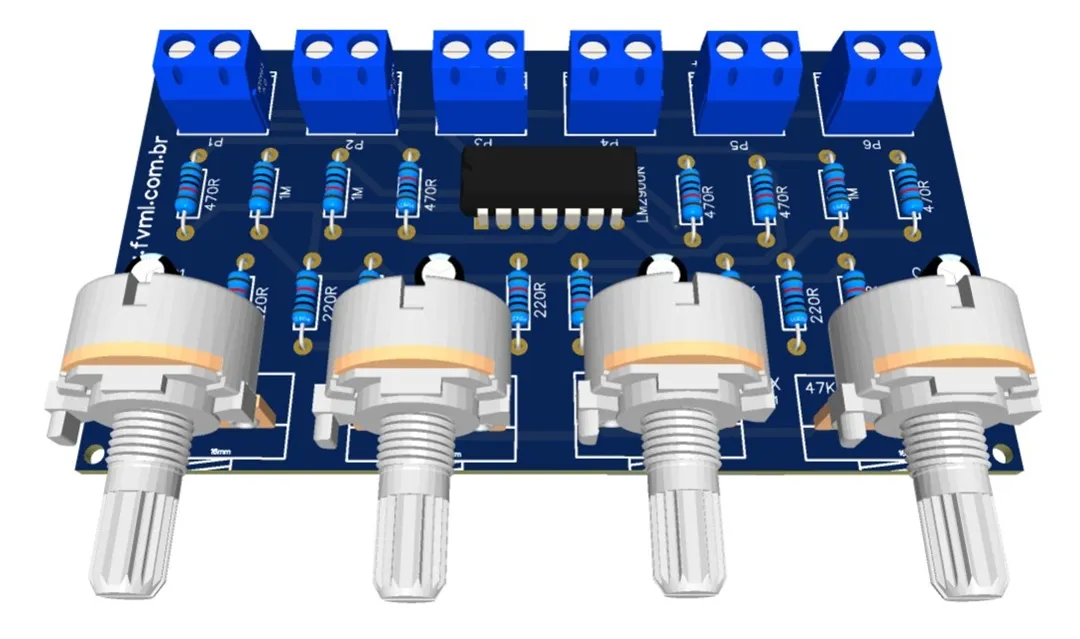
We provide the files of the printed circuit board, as well as the schematic diagram, in various formats such as PDF, GERBER and PNG. Additionally, we offer a direct link for free download of these files on a secure server, "MEGA".
🛠️ Assembly Tips
- Start by soldering the smaller components (resistors and diodes)
- Use a socket for the LM3900 IC to facilitate possible replacements
- Check twice the polarity of electrolytic capacitors before soldering
- Clean the board with isopropyl alcohol after soldering to remove flux residues
- Test each channel individually before making the final connection
📥 Direct Link to Download
To download the necessary files for assembling the electronic circuit, just click on the direct link provided below:
Download Link: PCB Layout, PDF, GERBER, JPG
🤔 Frequently Asked Questions (FAQ)
To ensure your project is a success, we've compiled some of the most common questions about this charger. Check it out!
Can I use the LM2900 IC instead of the LM3900? 🔽
Yes, the LM3900 is compatible with the LM2900. The main difference between them is the temperature range that each one supports. Both have 14 pins and can be used without problems in this circuit.
Is it possible to expand the number of channels of this mixer? 🔽
Yes! The number of channels can be doubled or even tripled, requiring only to assemble two or three identical circuits and make the association of them.
What is the recommended supply voltage for this circuit? 🔽
The LM3900 IC works with a wide range of power supply, from 4.5V to 32V. It can be used with single or symmetrical supply, and even with independent batteries for power.
Is this circuit suitable for beginners in electronics? 🔽
Yes, this is a relatively simple circuit, ideal for students and hobbyists who want to learn about audio mixers. However, care is needed when assembling not to invert the Integrated Circuit, which could damage it.
✨ Our Gratitude and Next Steps
We sincerely hope this guide has been useful and enriching for your projects! Thank you for dedicating your time to this content.
Your Feedback is Invaluable:
Have any questions, suggestions, or corrections? Feel free to share them in the comments below! Your contribution helps us refine this content for the entire ElCircuits community.
If you found this guide helpful, share the knowledge!
🔗 Share This GuideBest regards,
The ElCircuits Team ⚡