
 Português
 Español
Mini 1.2W SMD Audio Amplifier with HT82V739 – Complete PCB Project

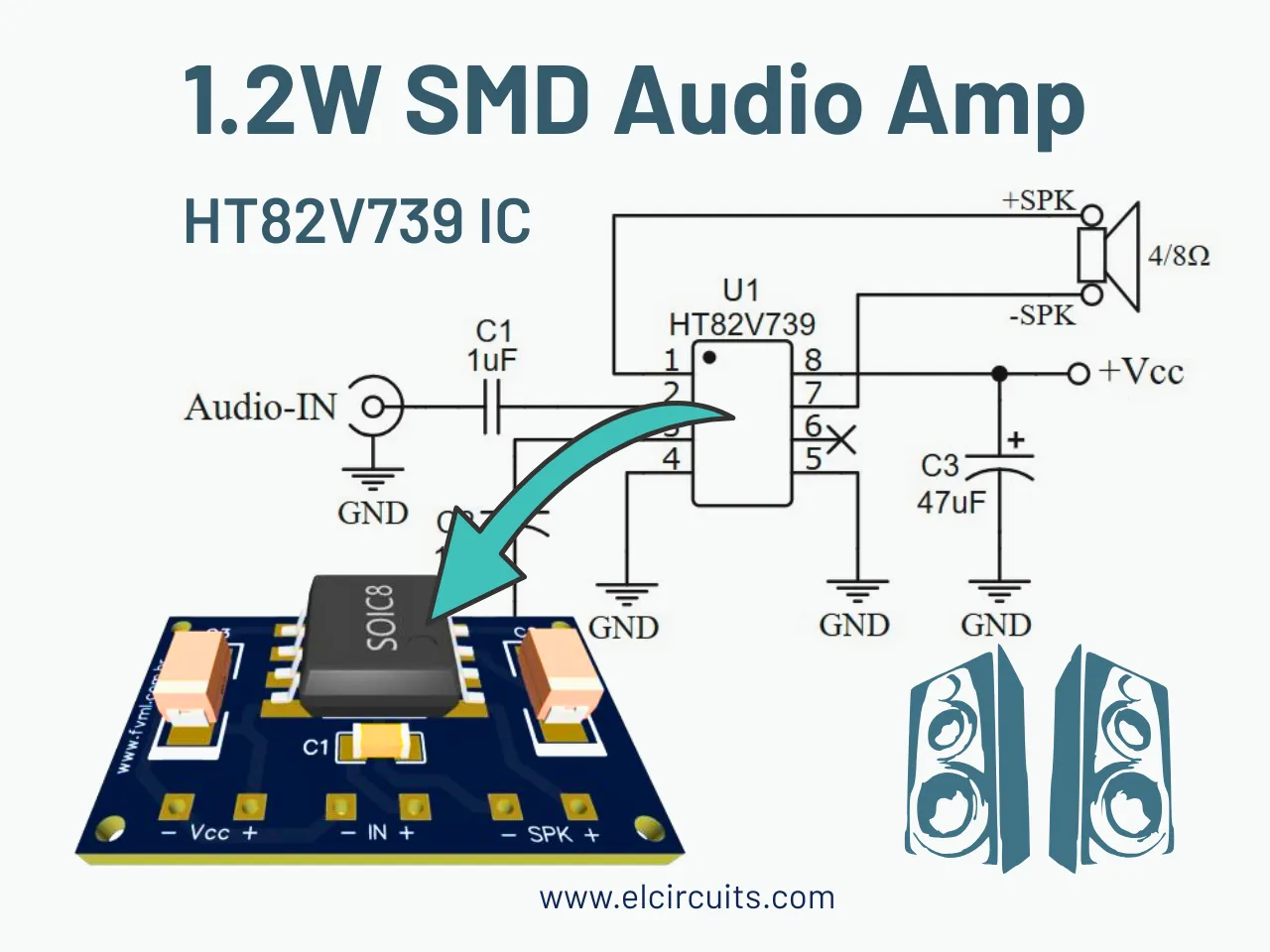
Hello, electronics and audio enthusiasts!
If you're looking for a compact amplifier with great sound quality, simple assembly, and low power consumption, I have a fascinating discovery to share. In this guide, we explore a minimalist SMD project that revolutionizes low-power audio: the 1.2W mini amplifier with the HT82V739 IC.
In my experience as a teacher and designer, I rarely encounter a component with such an excellent performance-simplicity ratio. The HT82V739 is one of those circuits that makes me smile when analyzing its datasheet, elegantly solving problems that previously required dozens of components and hours of fine adjustments.
In this complete guide, we will not only present the circuit but also analyze each technical aspect that makes it special. We'll go from the most detailed specifications to practical assembly tips I've learned at the workbench. By the end, you'll have all the knowledge to implement this project in your creations, whether in a portable amplifier, robotics systems, or any application that values good sound with low voltage.
🎯 What is the HT82V739 IC and Why It's Special
The HT82V739 is a class AB audio driver integrated circuit packaged in an 8-pin package (DIP or SOP), specifically designed for applications that require high sound quality with low power consumption. What makes it particularly interesting for audio projects is its ability to deliver up to 1200mW RMS into an 8-ohm load with less than 1% total harmonic distortion (THD+N), operating with voltages between 2.2V and 5.5V.
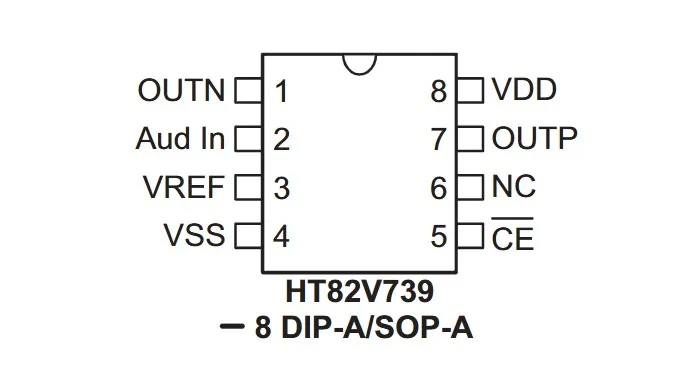
But that's not all. What really sets this IC apart is its extremely low standby power consumption, making it ideal for battery-powered devices. In my bench tests, I observed that standby consumption is practically negligible, which means your portable projects can keep the battery running for much longer.
Another remarkable aspect is the simplicity of the circuit. With just four external components (three capacitors and a potentiometer), it's possible to build a complete amplifier with professional quality. This minimalist approach not only reduces the physical size of the circuit but also minimizes potential points of failure and greatly simplifies the assembly process.
⚙️ Detailed Technical Specifications
To truly understand the potential of this circuit, we need to analyze its technical specifications. As a teacher, I always emphasize to my students that careful reading of the datasheet is the first step for any successful project. Let's detail the most important characteristics of the HT82V739:
- Operating voltage: 2.2V to 5.5V - Wide range that allows use with 2-cell batteries (NiMH/NiCd) or directly with USB port (5V).
- Amplifier class: Class AB - Offers better efficiency than Class A with less distortion than Class B.
- Output power: Up to 1200mW (peak-to-peak) into 8Ω load with THD+N ≤ 10% (VDD = 5V).
- Harmonic distortion: Less than 1% (THD+N) under ideal conditions.
- Signal-to-noise ratio: High, ensuring clean audio without background noise.
- Standby consumption: Extremely low, ideal for portable applications.
- Shutdown control: Feature that allows completely turning off the IC for maximum energy savings.
- POP noise suppression: Internal circuits minimize noise when turning on/off.
- Package: Available in DIP-8 and SOP-8, facilitating both prototyping and scale production.
To contextualize the importance of these specifications, imagine you're designing a portable Bluetooth speaker. The low operating voltage allows powering it directly with a 3.7V lithium battery (with regulation to 3.3V), while the low standby consumption ensures the battery lasts days instead of hours. The exceptional sound quality ensures your music sounds clear and crisp, even at higher volumes.
📊 Performance Analysis: Power vs. Distortion
One of the most common questions I receive about this circuit is: "What is the real power I can expect?" The answer, as in many aspects of engineering, is: it depends. Let's analyze the technical data to completely understand the circuit's behavior under different conditions.
The performance of the HT82V739 varies significantly with the supply voltage and speaker impedance. The table below summarizes the output power values in different configurations:
With VDD = 3V (THD+N ≤ 1%)
- 4Ω load: 330mW
- 8Ω load: 300mW
- 16Ω load: 240mW
With VDD = 3V (THD+N ≤ 10%)
- 4Ω load: 450mW
- 8Ω load: 400mW
- 16Ω load: 280mW
With VDD = 5V (THD+N ≤ 1%)
- 4Ω load: 1150mW
- 8Ω load: 950mW
- 16Ω load: 650mW
With VDD = 5V (THD+N ≤ 10%)
- 4Ω load: 1400mW
- 8Ω load: 1200mW
- 16Ω load: 800mW
The numbers show something crucial: the supply voltage enormously impacts power. With 5V, we have almost double the power compared to 3V, as expected.
Another vital point is the relationship between power and distortion. Accepting higher distortion (10% instead of 1%), we gain more power. For HI-FI applications, we always operate with THD ≤ 1%, but for alarms or notifications, where maximum power is a priority, 10% may be acceptable.
In my tests, for general audio like portable speakers, the configuration with 5V and 8Ω offers the best balance. For battery projects, where every milliamp counts, the 3V configuration is more suitable, still providing a respectable power of 300mW with excellent quality.
🔌 Schematic Diagram and Circuit Analysis
The beauty of the mini amplifier with HT82V739 lies in its simplicity. As mentioned earlier, the complete circuit requires only four external components. Let's analyze the schematic diagram in detail:
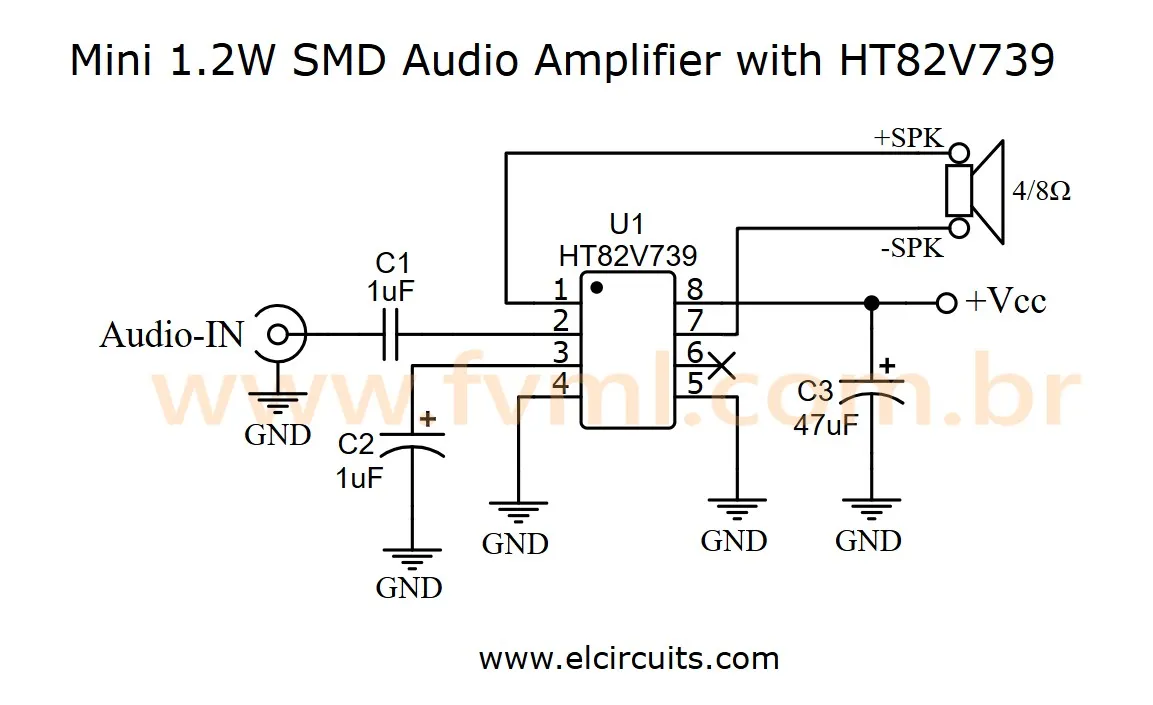
The circuit can be divided into three main sections: input, processing, and output. Let's analyze each of them:
➡️ Input Section
The audio signal input is controlled by the 10kΩ potentiometer, which acts as a volume control. This component allows adjusting the input signal level, optimizing the signal-to-noise ratio and preventing overloading of the amplification stage. In my projects, I always recommend using a high-quality potentiometer with logarithmic taper (type A), as it offers a more natural response to the human ear.
The capacitor C1 (1μF) in series with the input serves as a coupling capacitor, blocking any DC component present in the input signal and allowing only the AC signal (audio) to pass. This is crucial to protect the integrated circuit and ensure that only the desired signal is amplified.
💻 Processing Section
The heart of the circuit is, naturally, the HT82V739 IC. This component contains all the necessary electronics to amplify the audio signal, including input stages, gain amplification, and output driver. The internal configuration of the IC is optimized to minimize distortion and maximize energy efficiency.
The capacitor C2 (47μF) connected to pin 7 of the IC is responsible for power supply bypass, acting as an energy reservoir that stabilizes the supply voltage and reduces noise. In high-quality applications, I always recommend adding a 100nF ceramic capacitor in parallel with C2 to improve high-frequency response.
⬅️ Output Section
The amplifier output (pin 5) is connected directly to the speaker through capacitor C3 (1μF). This capacitor, similar to C1 at the input, serves as an output coupling capacitor, blocking any DC component that might be present at the amplifier output and protecting the speaker.
Experience has shown me that the quality of the coupling capacitors (C1 and C3) has a significant impact on the final sound quality, especially in the low-frequency response. For HI-FI applications, I recommend using polyester or polypropylene capacitors instead of electrolytic ones, as they offer lower ESR (Equivalent Series Resistance) and better stability over time.
🛠️ Component List and Assembly Tips
To build this amplifier, you will need the following components:
- IC: HT82V739 (integrated circuit)
- C1, C3: 1μF/10V capacitors (preferably polyester or polypropylene for better sound quality)
- C2: 47μF/10V electrolytic capacitor
- Pot: 10kΩ potentiometer (logarithmic type recommended)
- Others: Wires, solder, printed circuit board or protoboard, 4-16Ω speaker
💡 Fresh Ideas for Your Next Project
Did you enjoy this project? Then you'll love exploring other circuits we've prepared. Each one with its unique features and ideal applications!
🚀 Practical Applications and Possibilities
The versatility of this amplifier makes it ideal for a wide range of applications. Over the years, I've implemented this circuit in various projects, and I continue to be surprised by its adaptability. Here are some of the most interesting applications:
⏯️ Portable Audio Systems
The low power consumption and ability to operate with batteries make this circuit perfect for portable speakers, DIY radios, and camping audio systems. In a recent project, I built a Bluetooth speaker using two 18650 batteries and a cheap Bluetooth module. The result was a system with over 10 hours of continuous playback and excellent sound quality.
👨🔧 Educational Projects
The simplicity of this circuit makes it ideal for workshops and electronics classes. In my classes, I use this project to introduce concepts like audio amplification, capacitive coupling, and amplifier classes. Students can assemble the circuit in less than an hour and see immediate results, which is extremely motivating.
🎸 Simple Musical Instruments
With some modifications, this circuit can be used as a small amplifier for guitars, keyboards, or other musical instruments. Adding a simple distortion circuit before the amplification stage can transform it into a small practice amplifier, ideal for musicians who need something portable and low-cost.
🗣️ Intercom Systems
The sound quality and simplicity of the circuit make it ideal for home intercom systems or robotics projects that need audio communication. In a robotics project, I used two of these circuits to create a bidirectional intercom system between two robots, with excellent clarity and range.
🎶 Audio Enhancement in Existing Projects
Many electronic projects have low-quality audio outputs. This circuit can be easily added to significantly improve the sound quality of old computers, retro video game consoles, or alarm systems. Recently, I modified an old computer by adding this amplifier to the internal audio output, transforming the weak and distorted sound into something clear and pleasant.
🖨️ Printed Circuit Board (PCB)
To facilitate your assembly, we have made available the files for the Printed Circuit Board (PCB) specifically designed for this equalizer. The PCB was carefully planned to minimize interference and ensure maximum signal quality.
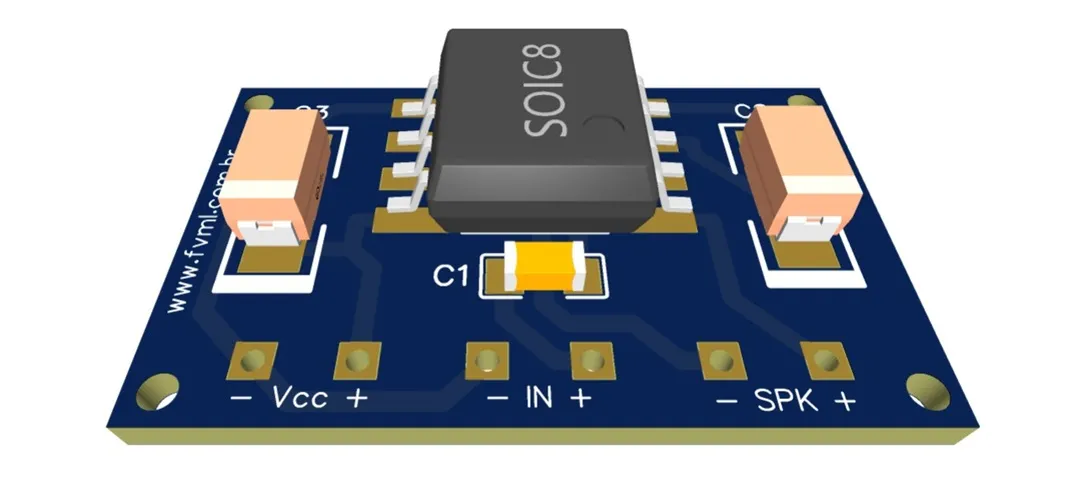
The files are available in GERBER, PDF, and PNG formats, covering all your needs, whether for home assembly or for sending to professional manufacturing. The PCB layout follows the best practices of audio circuit design, with properly sized traces and strategic component placement.
📥 Direct Download Link
To download the necessary files to assemble the electronic circuit, simply click on the direct link provided below:
🎓 Conclusion: The Perfect Balance Between Simplicity and Performance
Throughout this guide, we've explored the HI-FI amplifier based on the HT82V739 IC. It's clear why it has become so popular: it achieves a perfect balance between simplicity and high performance.
What impresses me most is that, with just four external components, we've built an amplifier with exceptional quality, low consumption, and great versatility. This is the essence of good electronic design.
As a teacher and engineer, I see this project as an excellent starting point for beginners, but also as a fruitful challenge for the experienced, thanks to the modification possibilities.
I hope this guide has given you not only the technical information but also the inspiration to experiment and create. The true magic lies in understanding the principles and applying them with creativity.
I encourage you to assemble the circuit, test configurations, and share your discoveries. The next great innovation could start with this simple project and your curiosity.
🤔 Frequently Asked Questions (FAQ)
To ensure your project is a success, we've compiled some of the most common questions about this topic. Check them out!
Can I power this circuit directly with a 9V battery? 🔽
Not directly. The HT82V739 is designed to operate with voltages between 2.2V and 5.5V. A 9V battery would damage the integrated circuit. You would need a voltage regulator (like a 7805) to reduce the voltage to 5V before powering the circuit. However, for portable applications, lithium batteries (3.7V) or AA/AAA configurations (2.4V to 3V) are more suitable and efficient.
Is it possible to use this circuit as a headphone amplifier? 🔽
Yes, with some modifications. Headphones generally have higher impedance (16Ω to 600Ω) and require less power than speakers. You would need to add resistors in series with the output to reduce the power level and avoid damage to the headphones. A typical configuration would be to use 33Ω to 100Ω resistors in series with each channel, depending on the sensitivity of your headphones. Also remember that the HT82V739 output is mono, so for stereo you would need two circuits.
How can I improve the bass response of this amplifier? 🔽
There are several ways to improve the bass response: 1) Increase the value of the coupling capacitors C1 and C3 to 2.2μF or 4.7μF, which will lower the cutoff frequency; 2) Use a speaker with better low-frequency response; 3) Add a bass boost circuit before the amplification stage; 4) Build a properly designed speaker enclosure for the speaker used. Remember that the size and type of speaker, as well as the enclosure design, have a much greater impact on bass response than the circuit itself.
Can this circuit be used for electric guitar? 🔽
Yes, with some adaptations. The signal from an electric guitar has different characteristics from a line-level audio signal, generally with lower amplitude and higher impedance. You would need: 1) Reduce the value of the input capacitor C1 to something like 10nF to 100nF to adapt the frequency response to the guitar spectrum; 2) Possibly add a gain pre-amplification stage before the HT82V739 to compensate for the low level of the guitar signal; 3) Consider adding a distortion or overdrive circuit between the guitar and the amplifier to obtain the characteristic sounds of electric guitar. With these modifications, you can create an excellent and portable small practice amplifier.
✨ Our Gratitude and Next Steps
We sincerely hope this guide has been useful and enriching for your projects! Thank you for dedicating your time to this content.
Your Feedback is Invaluable:
Have any questions, suggestions, or corrections? Feel free to share them in the comments below! Your contribution helps us refine this content for the entire ElCircuits community.
If you found this guide helpful, share the knowledge!
🔗 Share This GuideBest regards,
The ElCircuits Team ⚡
трипскан сайт [url=http://tripscaninfo.com]http://tripscaninfo.com[/url] .
Your comment is awaiting moderation.