Português
 Español
Adjustable LM338 Power Supply: 1.2 to 32V 5A with Short-Circuit Protection

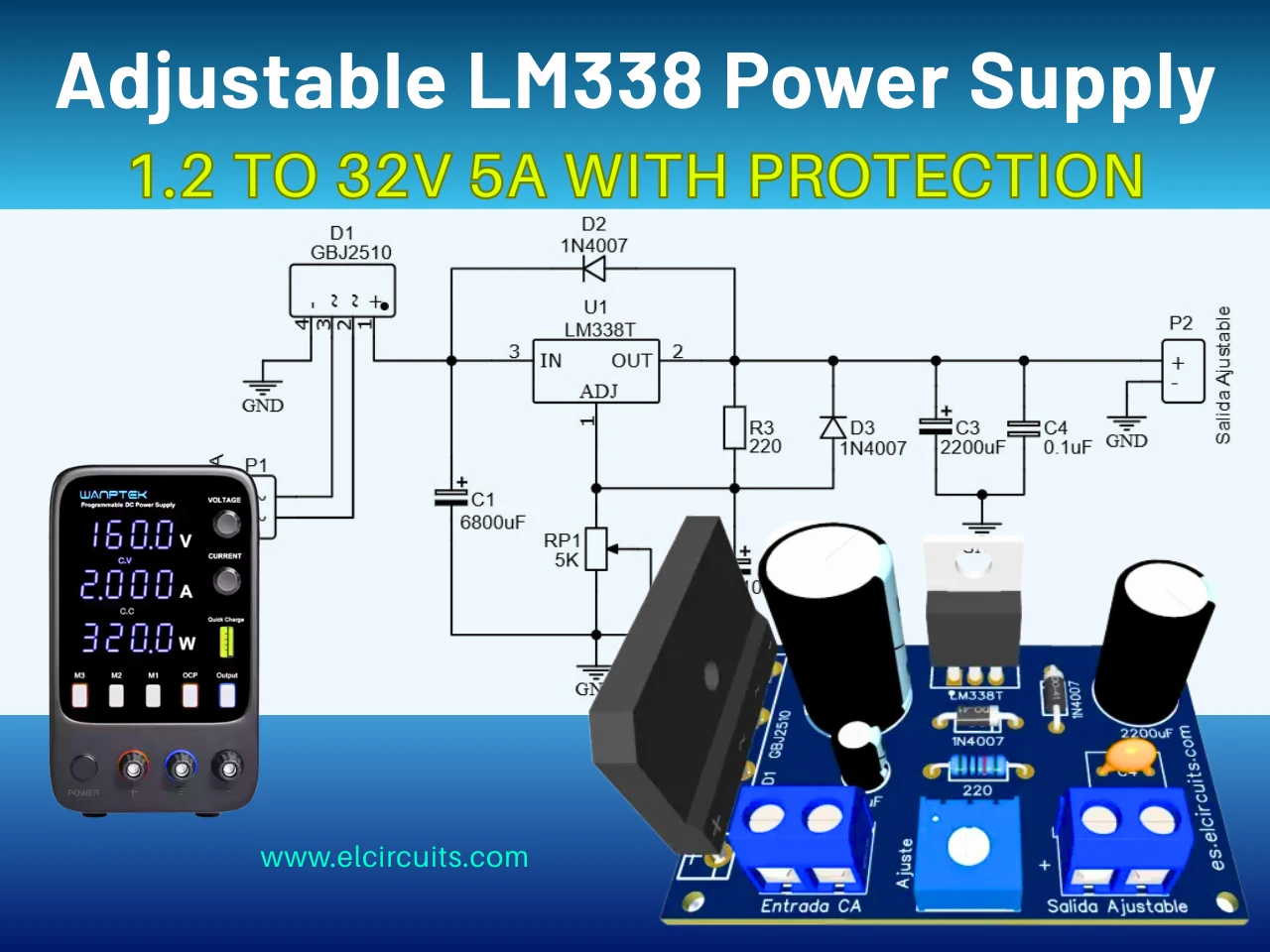
If you've ever found yourself at an electronics workbench trying to power a prototype with those cheap power supplies that barely regulate the voltage, you know exactly what I'm talking about. The frustration of seeing a project burn out due to a lack of a stable power supply is something every maker or technician has experienced at least once.
But what if I told you that you can build a professional bench power supply, adjustable from 1.2V to 32V with a whopping 5 amps of current, spending less than you would pay for a commercial power supply of dubious quality?
As an electronics professor for over a decade and having tested dozens of configurations on my own bench, I can state with authority: the LM338 is one of the most robust and reliable solutions for DIY bench power supplies. In this complete guide, I will show you step-by-step how to build your own adjustable power supply, explaining not just the "how," but mainly the "why" behind every component and design decision.
Get ready to have in your hands a power supply that rivals entry-level commercial equipment, and best of all: you will understand every inch of the circuit.
🔌 Why the LM338 is the Perfect Choice for Bench Power Supplies?
The LM338 is an adjustable three-terminal voltage regulator capable of supplying up to 5 continuous amps in a range of 1.2V to 33V. But what really sets it apart from other regulators in the 78xx family or even the popular LM317?
Here is the secret:
In my experience testing bench power supplies, I discovered that the LM338 offers three crucial advantages that make it practically indestructible, something I learned the hard way after frying a few LM317s in tests with heavy loads:
- Smart thermal current limiting: Think of the LM338 as a security guard who gets stricter as the situation heats up. It allows peaks of up to 12A for short periods (perfect for motors or lamps at startup), but automatically reduces to 5A in continuous mode, protecting itself against overheating.
- SOA Protection (Safe Operating Area): It's like having an electronic airbag. The internal circuit simultaneously monitors voltage, current, and temperature, ensuring the pass transistor never operates outside the safe zone, even if you accidentally cause a short circuit at the output.
- Thermal shutdown with hysteresis: If the chip temperature exceeds 125°C, it simply shuts down. When it cools down to about 100°C, it automatically turns back on. I tested this by placing the heatsink against a heat source: the LM338 survived; a 7805 would have turned into scrap.
But that's not all.
The configuration is surprisingly simple: just two external resistors define the entire voltage regulation. Compare that with switching regulators that require inductors, Schottky diodes, compensation loops... The LM338 is the definition of "robust simplicity".
📊 LM338 Technical Specifications (Real Lab Data)
- Output voltage range: 1.2V to 33V DC
- Continuous output current: 5A (guaranteed)
- Peak current (transients): Up to 12A for short periods
- Line regulation: 0.005%/V (practically negligible)
- Load regulation: 0.1% typical
- Dropout voltage: ~3V (minimum difference between input and output)
- Operating temperature: -55°C to +150°C
- Integrated protections: Thermal, short-circuit, and SOA
⚡ Complete Circuit Analysis: Understanding Each Component
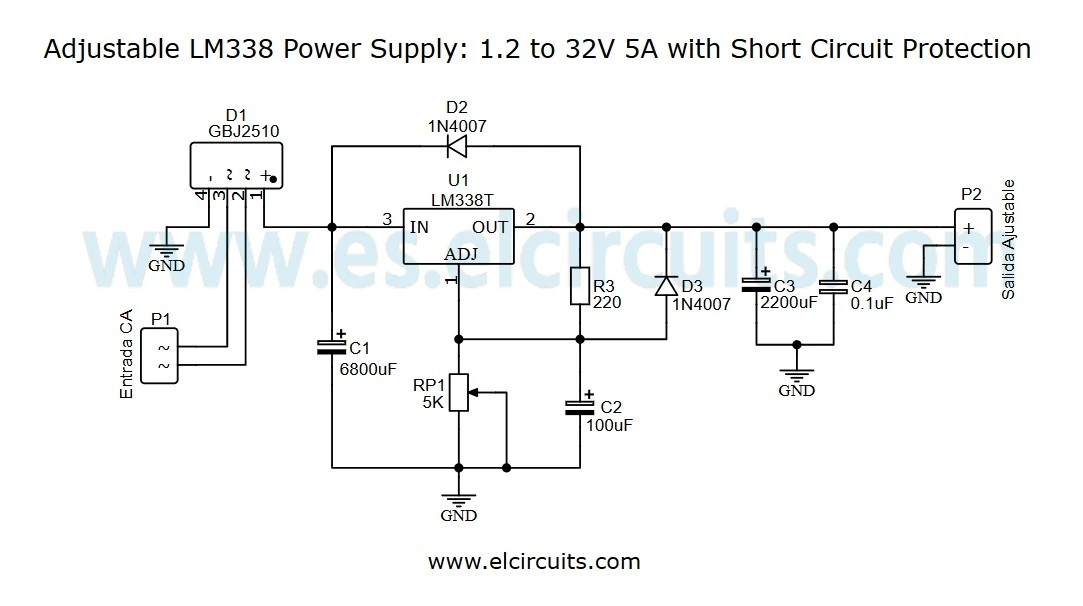
The circuit for this power supply was designed to maximize stability, minimize ripple, and guarantee full protection against failures. Let's dissect every stage of operation, and you will understand why each component is exactly where it is.
⚡ Stage 1: Input, Rectification, and Rough Filtering
AC Input and Bridge D1 (GBJ2510): The project starts with full-wave rectification. We use the GBJ2510 bridge, capable of supporting up to 25A. Although the power supply is 5A, this thermal margin ensures that the component works cool and supports current peaks without degrading. To achieve 32V DC at the output, a transformer of 24VAC to 28VAC with a secondary current of at least 5A is recommended.
Capacitor C1 (6800µF/50V): This is the lungs of the power supply. It smooths the pulsating waveform coming from the bridge. The golden rule here is 1000µF to 2000µF per Ampere of output. With 6800µF, we have an excellent compromise between size and filtering, ensuring that the regulator has a stable voltage to work with, even under maximum load.
🛡️ Stage 2: Protections and the LM338T "Brain"
Regulator U1 (LM338T): The heart of the system. It keeps the output voltage constant regardless of load variations. Attention: Since this is a linear regulator, excess voltage is dissipated as heat. A generous heatsink is mandatory to prevent the internal thermal protection from triggering the chip.
Protection Diodes D2 and D3 (1N4007): These are the bodyguards of the regulator. The D2 protects the LM338 in case the input is short-circuited, preventing the output capacitors from discharging into the chip. Meanwhile, D3 protects the adjustment pin (ADJ) against sudden discharge from capacitor C2. Without them, any failure or abrupt shutdown could burn the regulator instantly.
⚙️ Stage 3: Stability and Output Smoothing
Capacitor C2 (100µF): Connected to the adjustment pin, this capacitor filters any residual noise that could be amplified. Furthermore, it provides a Soft-Start effect (soft start), causing the voltage to rise gradually when the circuit is turned on, protecting the connected load.
Output Filtering (C3 2200µF and C4 0.1µF): C3 acts as a local reservoir for fast load transients, while C4 (ceramic) eliminates high-frequency noise. Together, they guarantee a "clean" DC output, essential for powering microcontrollers or sensitive audio circuits.
🎛️ Stage 4: Voltage Divider and Fine Adjustment
Resistor R3 (220Ω) and Potentiometer RP1 (5kΩ): This set defines the output voltage through the formula Vout = 1.25V * (1 + RP1/R3).
- Minimum: With RP1 at 0Ω, the output is the internal reference value: 1.25V.
- Maximum: With RP1 at 5kΩ, the output reaches approximately 29.6V. To reach exactly 32V, you can slightly reduce the value of R3 or use a higher commercial value potentiometer.
Engineer's Tip: To turn this project into a professional bench tool, replace the common potentiometer with a 10-turn multi-turn model. This allows you to adjust critical voltages, like 3.3V or 5.0V, with millimeter precision, something hard to achieve with single-turn potentiometers.
📝 Bill of Materials (BOM)
| Reference | Component | Suggested Specification | Function |
|---|---|---|---|
| U1 | LM338T | Adjustable Regulator (TO-220) | Main 5A Regulation |
| D1 | GBJ2510 | Bridge Rectifier 25A / 1000V | Full-wave rectification |
| D2, D3 | 1N4007 | Silicon Diode 1A / 1000V | Protection against reverse currents |
| C1 | 6800µF | Electrolytic (50V or 63V) | Rough filtering (Ripple) |
| C2 | 100µF | Electrolytic (50V) | ADJ pin filtering / Soft-start |
| C3 | 2200µF | Electrolytic (50V) | Output stabilization |
| C4 | 0.1µF | Ceramic or Polyester (100nF) | High frequency filter |
| R3 | 220Ω | Metal Film Resistor 1/2W | Voltage divider reference |
| RP1 | 5kΩ | Potentiometer (Linear or Multi-turn) | Output voltage adjustment |
| - | Heatsink | Large Aluminum (For TO-220) | LM338 thermal management |
Note: Do not forget to use good quality thermal paste between the LM338 and the heatsink. For continuous use at 5A, adding a 12V fan (cooler) is highly recommended.
🖨️ Professional PCB: Layout Optimized for Low Noise
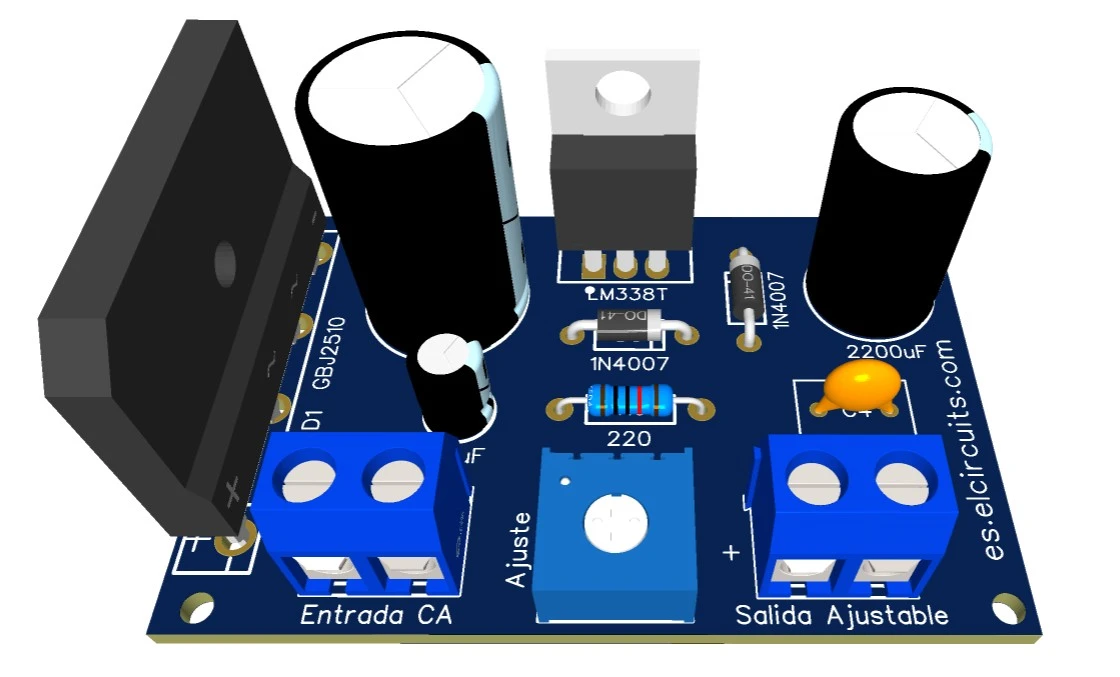
For those seeking professional results, the PCB layout is critical. I make the files available in GERBER formats (industrial manufacturing), PDF (thermal/homemade photosensitive method), and PNG (rapid prototyping).
📥 File Download
The files include annotated diagrams, bill of materials, and step-by-step assembly instructions:
🔧 Assembly Tips and Advanced Optimizations
Want to extract maximum performance from your project? Here are tricks I've learned over years on the bench:
❄️ Thermal Management
Power dissipation on the LM338 follows: P = (Vin - Vout) × Iout. In the worst case (1.2V out, 5A): P = (34 - 1.2) × 5 = 164W! Without an adequate heatsink, the chip will shut down in seconds.
Professional solution: Use a heatsink with an 80mm fan (12V PWM controlled). I managed to keep the LM338 at just 55°C running 5A continuous with this configuration.
🤔 Frequently Asked Questions (FAQ)
I have compiled the most common questions I receive from students and makers about this power supply. If your question isn't here, leave it in the comments!
Can I replace the LM338 with an LM317? 🔽
Technically yes, but I do not recommend it. The LM317 is limited to 1.5A continuous. If you try to draw 5A from it, the thermal shutdown will activate in a few seconds or, worse, the chip could fail catastrophically. For currents between 1.5A and 3A, consider the LM350 (3A). For 5A, the LM338 is irreplaceable in the family of simple linear regulators.
Why does my power supply heat up a lot even with a heatsink? 🔽
Linear regulators like the LM338 dissipate all voltage difference as heat: P = (Vin - Vout) × Iout. If you are regulating from 30V to 5V with a 3A load, you are dissipating (30-5)×3 = 75W! Solutions: 1) Use forced ventilation; 2) If possible, reduce the transformer voltage (use an 18VAC tap for low outputs); 3) Consider a switching pre-regulator before the LM338.
What is the exact function of diodes D2 and D3? Can I omit them? 🔽
Never omit these diodes! They protect against reverse currents that occur when: 1) External capacitors (at the output) discharge back into the regulator during shutdown; 2) Inductive load transients (motors, relays). Without them, the LM338 can suffer latch-up (destructive locking of the internal circuit). The cost of two 1N4007s is ridiculous compared to a fried LM338.
How do I add adjustable current limiting to this power supply? 🔽
The LM338 has internal limiting (~6-7A), but it is not adjustable. For precise limiting, add a comparator operational amplifier (TL081) monitoring the voltage drop across a 0.1Ω/5W shunt resistor at the output. When the current exceeds the limit (set by a second potentiometer), the op-amp diverts current from the LM338's ADJ pin, reducing the output voltage. This modification deserves its own article; I can detail it in a future post if there is interest!
Is it normal for the output voltage to drop when I increase the load current? 🔽
A small drop (0.1-0.3V) is acceptable due to load regulation and wire resistance. Larger drops indicate: 1) Undersized transformer (secondary voltage drops under load); 2) Wires too thin (use minimum 1.5mm² for 5A); 3) Resistive connections (cold solder, oxidized terminals). Check the voltage after C2; if it is stable, the problem is in the output circuit.
🎓 Conclusion: Your Bench Deserves a Real Power Supply
Building this power supply with LM338 is investing in the quality of your projects. With 1.2V to 32V and 5A, it is a robust and versatile tool. This guide brings together years of testing to ensure equipment that lasts decades, just like my prototype, in continuous use for 8 years. Download the files, build yours and share the result in the comments!
✨ Our Gratitude and Next Steps
We sincerely hope this guide has been useful and enriching for your projects! Thank you for dedicating your time to this content.
Your Feedback is Invaluable:
Have any questions, suggestions, or corrections? Feel free to share them in the comments below! Your contribution helps us refine this content for the entire ElCircuits community.
If you found this guide helpful, share the knowledge!
🔗 Share This GuideBest regards,
The ElCircuits Team ⚡