
 Português
 Español
What Is a Direct Box (DI)? How It Works and Impedance Explained

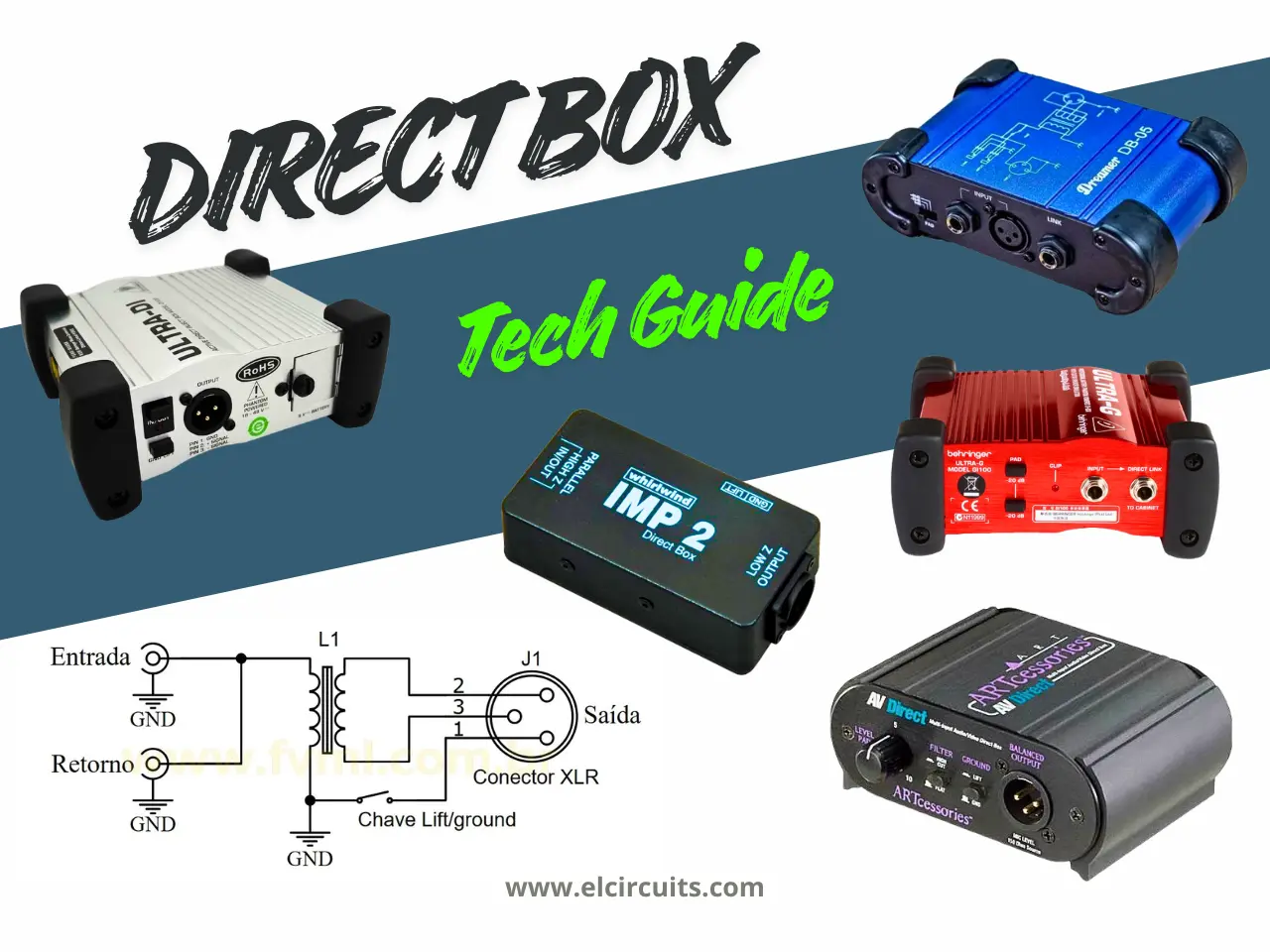
Hello, fellow sound technicians, audio operators, and students.
If you have ever faced signal integrity deterioration in high-impedance instruments over long distances, or encountered ground loops manifested as low-frequency hums (50/60Hz), you have witnessed in practice the need for a Direct Box (DI).
From an engineering perspective, the DI is not merely an adapter, but a critical impedance interface. It solves fundamental problems of circuit theory: impedance matching to maximize voltage transfer, the conversion of unbalanced to balanced (differential) signals for common-mode noise rejection (CMRR), and galvanic isolation.
In this technical analysis, we will dissect the physics behind DIs, differentiating the passive topology (transformers) from the active one (integrated circuits). The lesson has begun.
🤔 What is a Direct Box (DI)?
A Direct Box (Direct Injection) is an impedance conversion device and signal balancer. Its primary function is to transform a high-impedance signal (high Z_in, typically in the kΩ to MΩ range) and unbalanced (asymmetrical), into a low-impedance signal (low Z_out, typically <600Ω) and balanced (symmetrical).
How Does the Physics of This Matching Work?
Instruments with passive pickups (such as guitars) generate an electromotive force with high internal impedance. When connecting them directly to long cables, the cable's parasitic capacitance forms a low-pass filter with the instrument's output impedance, attenuating highs. Furthermore, the mixing console's input expects low-impedance signals.
The DI acts as a "buffer," presenting a high impedance to the instrument (to avoid loading it down) and delivering a low impedance to the console, allowing the signal to travel hundreds of meters without audible frequency loss.
It is an indispensable component to ensure signal integrity in studios and professional sound reinforcement (PA), ensuring the rejection of electromagnetic interference.
🛠️ Operation and Construction Fundamentals
The architecture of a quality DI is based on rigorous physical principles to ensure noise immunity. Let's analyze the two constructive pillars:
1. The Metallic Casing (Electrostatic Shielding)
The metallic construction is not merely structural. It acts as a Faraday Cage. In environments saturated with RF (Radio Frequency) and electromagnetic fields, the grounded metallic casing diverts induced noise currents to the ground, preventing them from penetrating the sensitive audio circuit. This is crucial for maintaining a high signal-to-noise ratio (SNR).
2. The Audio Transformer (Passive Topology)
At the heart of the passive DI lies the audio transformer. Based on the Faraday-Neumann-Lenz law, the transformer performs two vital functions through the turns ratio (N):
- Impedance Transformation: Impedance is transformed by the square of the turns ratio Z_p = N² ⋅ Z_s. A transformer with a voltage step-down ratio, for example 12:1, reduces the signal voltage but drastically lowers the output impedance to values close to 150 - 300Ω, ideal for the microphone input of the console.
- Galvanic Isolation: Since there is no direct electrical connection (wire-to-wire) between the primary (input) and the secondary (output), only magnetic coupling, a physical barrier is created for direct currents (DC) and common-mode noise. This is what effectively breaks ground loops.
🔌 Electrical Schematic Analysis
Let us observe the schematic diagram of Figure 2. The topology reveals the elegant simplicity and effectiveness of the passive design:
- Input and Thru (Bypass): The signal enters the 1/4" connector (P10). The "Thru" is a pure and direct parallel connection. It allows the original signal (high impedance) to go to a local amplifier (stage), while the signal processed by the DI goes to the console. Note that there is no buffer here; using long cables on the Thru output can still affect the instrument's response.
- The Transformer: The signal passes through the magnetic core of the transformer. Here, the conversion from unbalanced to balanced occurs. Common-mode rejection (CMRR) depends on the perfect balancing of the secondary coils.
- Balanced Output (XLR): The signal exits through pins 2 (hot/+) and 3 (cold/-). The ground reference (pin 1) is managed by the "Ground Lift" switch, which, when open, maintains galvanic isolation, preventing potential ground differences between the stage and the PA from circulating current through the audio cable.
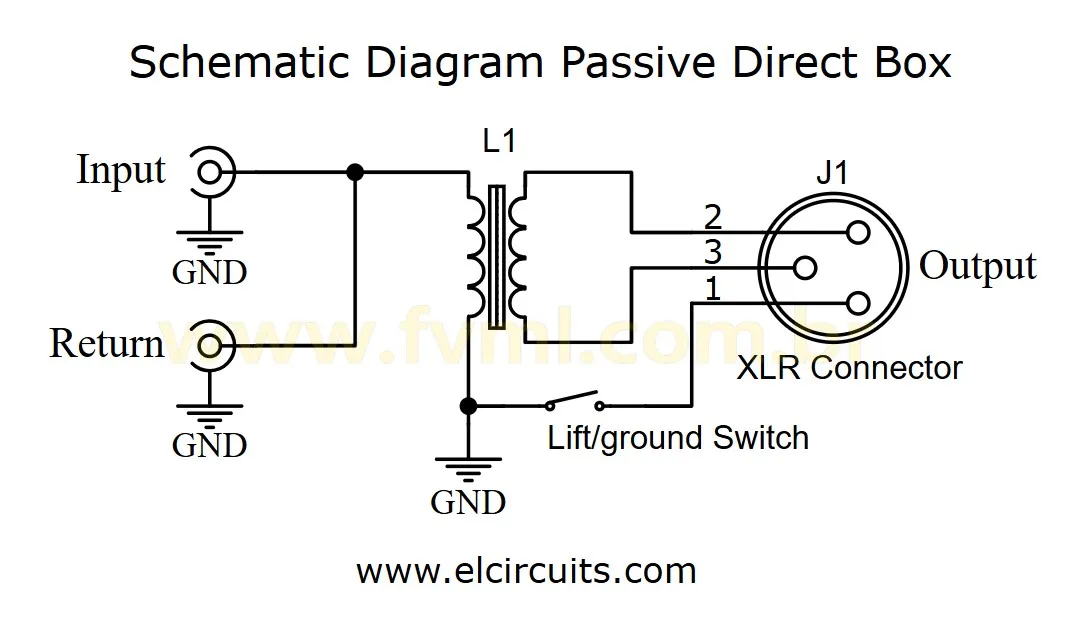
The use of this device eliminates the inadequacy of using high-capacitance coaxial cables (1/4" / P10) over long distances. By converting to balanced low impedance, the signal becomes robust enough to travel through shielded twisted pair cables (XLR) with immunity to interference and negligible frequency response loss.
⚙️ Technical Controls and Functionality
Besides conversion, specific controls allow the adaptation of the DI to different engineering scenarios. Understanding the electronics behind them is essential:
-
Attenuation Switch (Pad): This is a resistive voltage divider (ladder attenuator) before the conversion stage. Its function is to prevent magnetic core saturation (in passive DIs) or rail voltage "clipping" (in active DIs) when subjected to high-level signals, such as keyboard line outputs or external preamplifiers. In transformers, magnetic saturation generates non-linear odd harmonic distortion, which is undesirable.
-
Ground / Lift Switch: This switch interrupts the physical connection between the input equipment's ground (instrument/amplifier) and the mixing console's ground (XLR Pin 1). If there is a ground potential difference between the stage and the sound system, a current will circulate through the cable (ground loop), inducing 50/60Hz noise. By lifting the ground (Lift), this current path is broken, eliminating the noise without compromising the balanced signal reference.
-
Low-Cut Switch (High Pass Filter): A passive or active RC filter that attenuates frequencies below a pre-defined cutoff point (e.g., 80Hz, 18dB/octave). Its technical function is to remove unnecessary sub-bass energy that consumes dynamic "headroom" and can cause coupling problems in subwoofers, in addition to reducing mechanical handling noise. It should be avoided in instruments whose fundamental harmonic content lies in this range, such as five-string basses.
🔧 Topologies: Passive vs. Active
The choice between a Passive and Active DI lies in understanding the output impedance of the sound source and the desired energy transfer characteristics. The engineering golden rule is: Impedance matching for power transfer, and 'Bridging' (load impedance >> source impedance) for voltage transfer.
Passive Direct Box: Pure Magnetic Induction
Based entirely on transformer physics. It does not require external power, operating exclusively with the input signal's energy. It is a dissipative system; there are inherent losses due to copper resistance and the core's magnetic hysteresis.
✅ Technical Fundamentals of the Passive DI:
- Autonomy and Reliability: The absence of active components (transistors, electrolytic capacitors) eliminates failures due to battery exhaustion or semiconductor thermal noise. The useful lifespan is virtually infinite if the transformer is of quality.
- Dynamic Headroom for Hot Signals: Unlike integrated circuits that have rigid rail voltage limits (e.g.: ±15V), a high-quality transformer can handle high-voltage transients without distortion, provided it does not reach core saturation. Ideal for active line outputs.
- Total Galvanic Isolation: The physical separation between primary and secondary ensures perfect isolation, solving complex ground loop problems passively.
❌ Technical Limitations of the Passive DI:
- Insertion Loss: Due to the step-down turns ratio, there is a natural attenuation in signal level (generally -12dB to -20dB). For passive instruments with low output amplitude, this can result in an unfavorable signal-to-noise ratio at the console's preamplifier input.
- Frequency Response and Saturation: Low-cost transformers suffer from irregular response at extreme frequencies (bass and treble) due to inductance and parasitic capacitance. Furthermore, very intense signals can saturate the core, generating harmonic distortion. High-performance transformers (e.g.: Jensen, Lundahl) minimize this with high-permeability nickel or silicon steel cores, but at a higher cost.
Active Direct Box: Operational Amplification
Uses active electronic circuits (Operational Amplifiers or Field Effect Transistors - FETs) to process the signal. It requires a DC power source (battery, power supply, or 48V Phantom Power) to bias the components.
✅ Technical Fundamentals of the Active DI:
- High Impedance Buffer: The input stage of an active DI presents an extremely high input impedance (MΩ) and low input capacitance. This forms an ideal "buffer" for passive pickups, ensuring that the pickup resonance is not dampened ("loaded down"), preserving the entire high harmonic spectrum and the instrument's "brightness".
- Voltage Gain: Unlike the passive DI, the active DI can provide gain, raising the signal level before sending it to the console. This is crucial for low-output instruments (piezo violins, single coil guitars) to compete with the system's noise floor.
- Bandwidth: Quality active circuits offer a flat response from DC to ultrasonic frequencies (>50kHz), without the magnetic saturation problems inherent to transformers, guaranteeing absolute transparency.
❌ Technical Limitations of the Active DI:
- Voltage Clipping: If the input signal amplitude exceeds the supply voltage (rails), the circuit will suffer "hard clipping" (abrupt cut-off), generating even harmonic distortion, which is auditorily unpleasant and can damage tweeters. It should not be used in high-level outputs without attenuation (Pad).
- Complexity and Noise: The addition of active components introduces thermal noise (Johnson-Nyquist noise) and instability. In addition, the dependence on energy creates a failure point; without power, the system ceases to function.
- Partial Isolation: Most active DIs do not have total galvanic isolation unless they include an output transformer (hybrid topology).
📋 Summary: Practical Application Guide
To solidify theoretical knowledge, I present a decision table based on the impedance and level characteristics of the sound source:
| Sound Source | Indicated DI | Technical Justification |
|---|---|---|
| Passive Guitar (Magnetic) | Active | High output impedance requires an active buffer to avoid high-frequency loss (capacitive loading effect) and gain to overcome noise. |
| Passive Bass | Active | Preserves transient response and high harmonics fundamental for the attack "definition," maintaining the integrity of the low-amplitude signal. |
| Active Bass / Keyboard / Sampler | Passive | Low impedance and high-level ("line level") sources. The passive transformer offers isolation, robustness, and avoids the clipping that would occur in an active DI. |
| Amplifier Output (Power Amp) | Passive (High Power) | Critical Attention: Only specific passive DIs (with series resistance and adequate thermal dissipation) can sample the speaker signal. A common or active DI will be destroyed by the high voltage and current. |
🤔 Frequently Asked Questions (FAQ)
We have compiled the most recurring doubts about audio interfaces and circuit theory to elucidate practical concepts.
Why not connect an instrument directly to the console with a long 1/4" cable? 🔽
Technically, the cable's parasitic capacitance (typically 50-100pF/meter) forms a low-pass filter with the pickup's high output impedance. This results in the loss of high frequencies ("muffled sound"). Furthermore, the unbalanced signal acts as an antenna for EMI/RFI, and the ground potential difference between the instrument and the console creates a ground loop. The DI solves all these electrical problems.
What is the exact technical function of the "Ground Lift" switch? 🔽
The Ground Lift switch interrupts the connection of pin 1 (ground/chassis) of the output XLR connector. It is used to break the conductive path of current between the source equipment's ground (e.g.: amplifier ground on stage) and the mixing console's ground (PA). Without this conductive path, ground loop current cannot flow, eliminating the 50/60Hz hum induced by ground potential differences.
Active or Passive Direct Box: What is the correct choice for Engineering? 🔽
The choice depends on the "Source Output Impedance". High impedance and low-level sources (passive magnetic pickups) require the high input impedance ($Z_{in}$) of an Active DI to maintain a flat frequency response. Low impedance and high-level sources (active line outputs, keyboards) benefit from the simplicity, headroom, and galvanic isolation of a Passive DI.
💡 Fresh Ideas for Your Next Project
Did you enjoy this project? Then you'll love exploring other circuits we've prepared. Each one with its unique features and ideal applications!
📝 Technical Conclusion
As a teacher and based on my experience as a sound technician, the recommendation is based on physics: for passive signal sources and high impedance, the Active DI is mandatory to ensure frequency response integrity. For active sources, line-level, or when galvanic isolation is a priority, the high-quality Passive DI is the technical choice.
A high-quality transformer (like Jensen or CineMag) in a passive DI often surpasses the linear response of cheap active circuits, offering also the advantage of electrical isolation. On the other hand, an active DI with low-noise and low-distortion operational amplifiers (e.g.: Burr-Brown) is irreplaceable for capturing acoustic instruments and passive guitars.
Mastering these concepts of impedance matching and signal balancing elevates the level of applied audio engineering. Technical knowledge separates the amateur from the professional who understands not just the "how," but the "why" of things.
If doubts remain about electrical parameters, CMRR, or specific applications, I invite you to leave your comments to discuss the theory in more depth. Share this technical knowledge with your peers.
✨ Our Gratitude and Next Steps
We sincerely hope this guide has been useful and enriching for your projects! Thank you for dedicating your time to this content.
Your Feedback is Invaluable:
Have any questions, suggestions, or corrections? Feel free to share them in the comments below! Your contribution helps us refine this content for the entire ElCircuits community.
If you found this guide helpful, share the knowledge!
🔗 Share This GuideBest regards,
The ElCircuits Team ⚡

Обратитесь за [url=https://studencheskie-raboty.online/]помощью с учебой[/url].
Профессиональная поддержка включает составление плана, формирование структуры и поиск проверенной литературы.
По завершении написания основного текста выполняется контроль всей работы.
Качественная поддержка помогает оставить авторскую манеру изложения и выполнить персональные требования преподавателя.
При таком подходе студент контролирует материал и получает возможность уточнять детали на всех этапах.
Your comment is awaiting moderation.