Português
 Español
Gainclone LM3876: High Performance 56W Amplifier + PCB

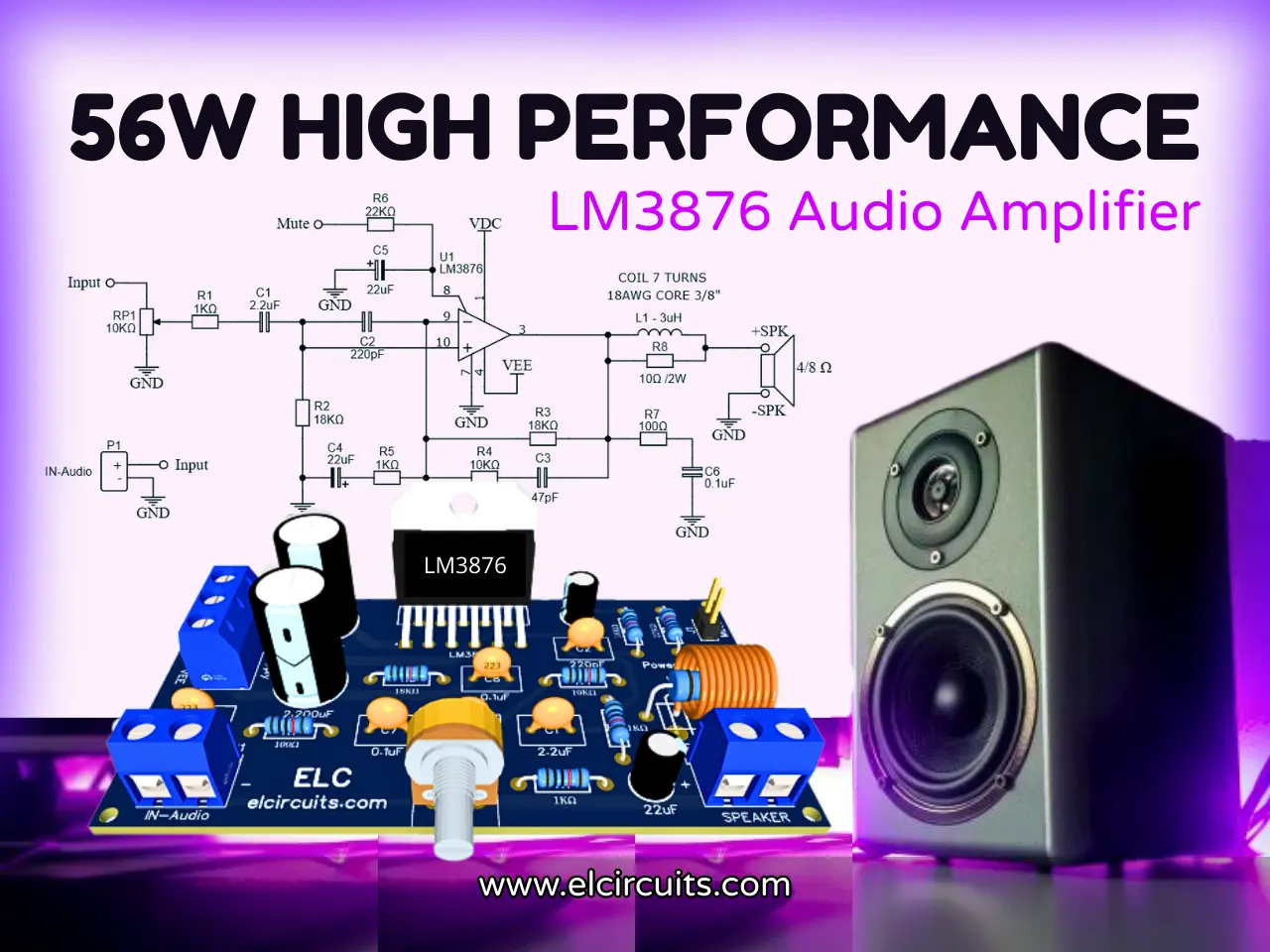
56W High Performance Audio Amplifier with LM3876: The Definitive Guide for Hi-Fi Builders
Have you ever missed that "impact" when listening to your favorite music? Building your own audio amplifier is not just a fascinating technical exercise, but the gateway to a sound quality that shelf equipment rarely achieves. Today, we will dissect a classic audio engineering project: the 56W Power Amplifier based on the LM3876 IC.
As a professor and electronics enthusiast, I have assembled dozens of amplifiers, from expensive valve models to discreet single-transistor projects. However, the integrated amplifiers of the LM series from Texas Instruments (formerly National Semiconductor) hold a special place in my heart. They offer a cost-benefit ratio and a failure immunity that discrete projects often require dozens of extra components to replicate.
In this article, I will guide you through every detail of this project, from the theory behind the integrated circuit to the practical assembly tips that only bench experience teaches. Ready to raise the level of your sound system? Let's go.
💎 The Heart of the Project: The LM3876 Integrated Circuit
The LM3876 is a high-performance audio power amplifier capable of delivering 56W of continuous average power into an 8Ω load with total distortion of just 0.1%.
But what does this mean in practice? Imagine a car engine. Having power is easy; having power with smoothness and without hiccups is the real challenge. The LM3876 delivers clean energy across the entire audible range (from 20Hz to 20kHz), maintaining signal fidelity.
In my bench tests, what impresses me most about this IC is not just the power, but the silence. With a typical Signal-to-Noise Ratio (SNR) greater than 95dB and a noise floor of only 2.0μV, you hear the music, not the typical "hiss" of poorly designed amplifiers. It is that "darkness" between musical notes that defines Hi-Fi equipment.
SPiKe Technology: Your Life Insurance on the Bench
One of the biggest nightmares for those assembling amplifiers is accidental burnout. A short at the output, a voltage spike in the power supply, and that's it: expensive components go to waste. The LM3876 solves this with a technology called SPiKe (Self Peak Instantaneous Temperature Ke).
Think of SPiKe as an electronic "airbag." It dynamically monitors the Safe Operating Area (SOA) of the IC. If there is overvoltage, undervoltage, overload, short-circuit to the supply rails, or instantaneous temperature peaks, the circuit disarms or limits the current automatically. For students and hobbyists, this means much greater durability compared to discrete transistor projects, where a simple error can be fatal.
Relevant Technical Specifications
Before we get our hands dirty, let's look at the cold numbers. The little table below summarizes what this "monster" can do:
- Output Power: 56W continuous into 8Ω (THD+N 0.1%).
- Peak Power: Up to 100W instantaneous.
- Total Harmonic Distortion (THD+N): Typical 0.06%.
- Intermodulation (IMD): Typical 0.004% — an excellent number for sound clarity.
- Supply: Wide range from 20V to 94V (total symmetrical).
- Protections: Against short-circuit, overload, inductive transients, and thermal spikes.
🔌 Schematic Circuit Analysis
The circuit is purposefully minimalistic, using few external components to configure gain and stability, which facilitates assembly and reduces failure points.
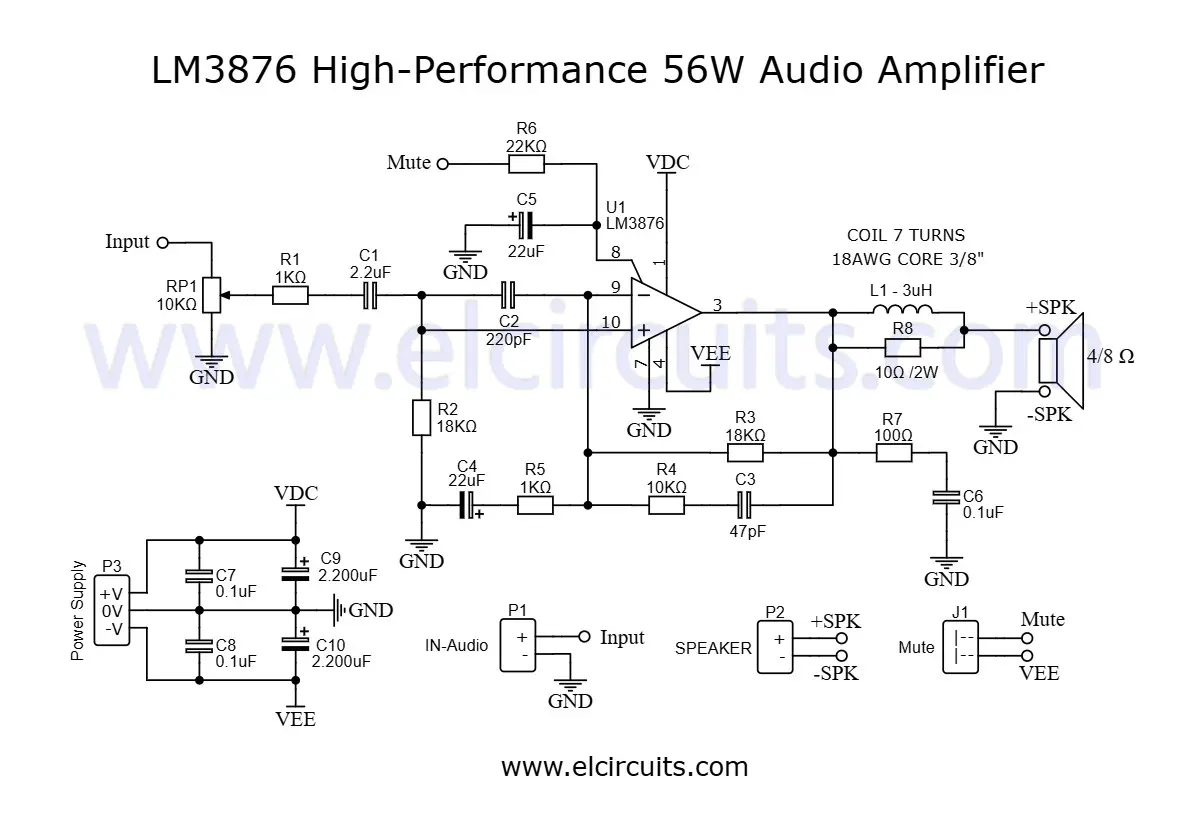
Looking at the schematic in Figure 2, we see a standard topology for high-power operational amplifiers. Do not be fooled by the simplicity; every component there has a critical role.
- Voltage Gain: The circuit is configured for non-inverting gain. The feedback network (formed by resistors and capacitors connected to pin 10) sets this gain. Generally, we keep the gain between 20 and 30 times. Too much gain amplifies noise; too little, and you cannot drive the amplifier with common signal sources (like cell phones or players).
- Input Filter: The input resistor and capacitor form a soft low-pass filter, preventing radio frequencies (RF) from invading the amplifier and causing interference.
Here is a professor's tip: Be careful with the polarity of electrolytic capacitors! Reversing the polarity of C4 or C5 can result in a literal explosion or, at the very least, crossover distortion.
The Importance of the Output Coil (L1)
You will notice in the schematic, in series with the output, a 3μH coil (L1). Many beginners ask me: "Professor, can I skip this coil?". The short answer is: no.
This coil, usually built with 7 turns of 18 AWG wire on a 3/8" air core, serves to isolate the amplifier from capacitive loads (like long speaker cables). Without it, the amplifier may oscillate at high frequencies, generating excessive heat without you audibly noticing it. It is a small component that avoids big headaches.
🧾 Bill of Materials (BOM)
To ensure project success, follow this materials list strictly, paying attention to the voltage values of the capacitors.
A common mistake is using capacitors with a working voltage below what is necessary. Since we will be working with +/- 35V rails, your electrolytic capacitors must be at least 50V or 63V for safety.
- Semiconductors
- U1: LM3876 Integrated Circuit (11-lead TO-220 package).
- Resistors (1/4W Carbon or Metal Film)
- R1, R5: 1KΩ (brown, black, red).
- R2, R3: 18KΩ (brown, gray, orange).
- R4: 10KΩ (brown, black, orange).
- R6: 22KΩ (red, red, orange).
- R7: 100Ω (brown, black, brown).
- R8: 10Ω / 2W (power resistor).
- RP1: 10KΩ Trimpot or Potentiometer (volume/offset adjustment).
- Capacitors
- C1: 2.2μF Ceramic or Polyester (audio input).
- C2: 220pF Ceramic.
- C3: 47pF Ceramic.
- C4, C5: 22μF / 50V Electrolytic.
- C6, C7, C8: 0.1μF (100nF) Ceramic or Polyester (decoupling).
- C9, C10: 2.200μF / 50V Electrolytic (main filters).
- Other Components
- L1: 3μH Inductor (Homemade: 7 turns 18AWG wire 3/8" air core).
- Connectors: 5mm screw terminals (2 and 3 pins).
- Heat Sink: Essential. The IC must be electrically isolated from the heat sink using mica and an isolated screw.
⚡ The Power Supply: The Soul of the Amplifier
To extract the promised 56W, you need a symmetrical power supply of ±35VDC, derived from a 24VAC transformer with a "Center Tap".
Many students try to use generic computer switching power supplies. Do not do that. Linear power supplies (transformer + rectifier + capacitor) are superior for analog audio because they have lower switching noise and handle dynamic music current peaks better.
Sizing the Power Supply
- Transformer: Primary for your local mains (110/220V), Secondary 24V-0-24V (Center Tap). This provides about 34V to 35V DC after rectification.
- Filter Capacitors: The value of 2.200μF per rail (suggested in the list) is a good start. Personally, I usually use 4.700μF or more to have a larger energy "reservoir" for heavy bass.
- Current: For a mono channel, 3 Amperes is the acceptable minimum. If you are building a Stereo system (two channels), you should double this to 6 Amperes. An undersized power supply causes the sound to "clip" (distort) at high volumes and overheat the transformer.
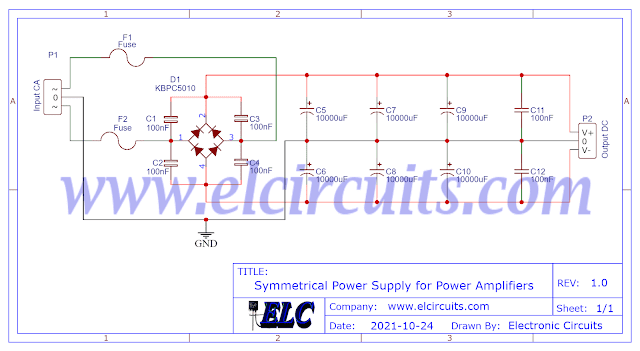
In Figure 3, I present a robust symmetrical power supply schematic that serves perfectly for this and other amplifier projects. It is a project I developed to be easy to calculate and modify.
🖨️ Assembly and PCB (Printed Circuit Board)
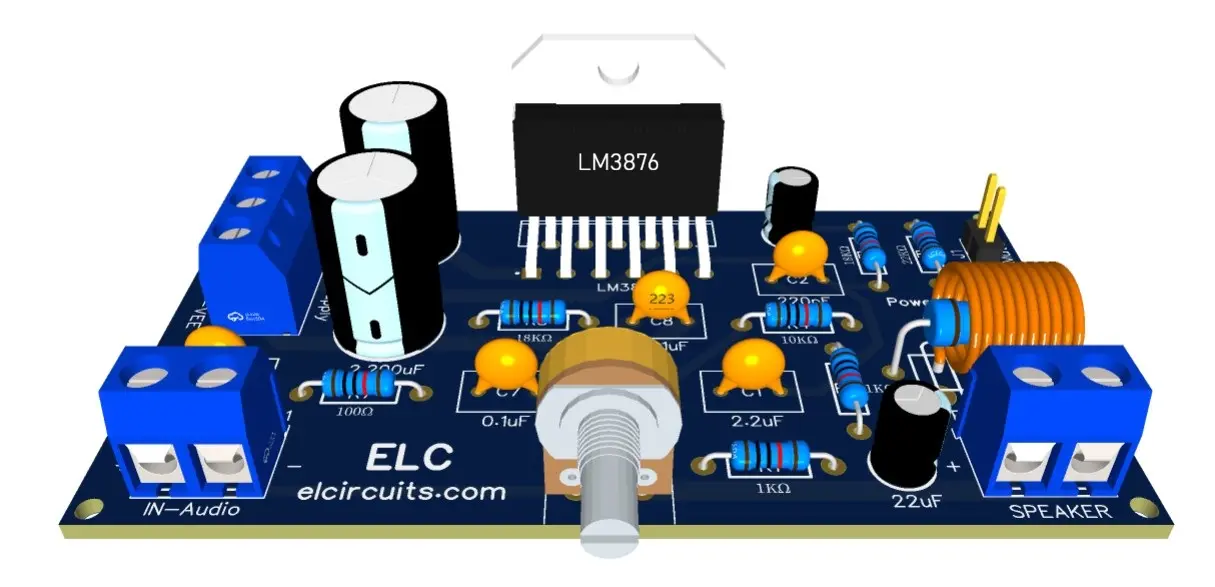
The component layout on the PCB (Figure 4) was designed to minimize ground loops and noise, provided in GERBER, PDF, and PNG formats for direct download.
When soldering, follow this logical order to avoid errors:
- Resistors: Lower components, easy to solder.
- Sockets/Connectors: Facilitate future replacements, although the LM3876 is robust.
- Capacitors: Be careful with polarization!
- IC and Heatsink: Mount the LM3876 on the heatsink before soldering its pins to the board. This avoids mechanical stress on the terminals.
Remember: the heatsink is not optional. At high powers, the LM3876 can dissipate tens of watts in heat. A small heatsink will cause the IC to enter thermal protection (SPiKe), cutting the sound intermittently.
📥 File Download (Direct Link)
To make your life easier, I provide the files for free. You can send the GERBER files directly to a PCB factory or print the PDF for the thermal transfer method (clothes iron) if you make it yourself at home.
👉 Click here to download the GERBER, PDF, and PNG files on MEGA
🤔 Frequently Asked Questions (FAQ)
To ensure your project is a success, we have compiled some of the most common questions about this topic. Check them out!
Can I use the LM3876 in bridge mode to get more power? 🔽
Yes, it is possible. Two LM3876s can be configured in bridge to provide up to 100W into 8Ω or 16Ω loads. However, this requires a phase inverting circuit at the input and great care with heat dissipation, as the current through the load doubles.
What is the practical difference between the LM3876 and the famous LM3886? 🔽
The LM3886 is a "turbocharged" version of the LM3876. While the LM3876 delivers 56W, the LM3886 reaches 68W. Both have the same SPiKe protection and similar pinout, but the LM3886 is more common in modern higher power projects. If you already have the LM3876, it serves perfectly for a standard living room.
The amplifier turns on but has no sound, what should I check? 🔽
First, check the MUTE/STANDBY jumper (Connector J1). For the amplifier to work, the MUTE/STANDBY pin must have a minimum output current from pin 8 > 0.5 mA (the 22kΩ resistor (R6) connected to VEE). If this pin is floating or has high impedance “open,” the IC will remain mute. Also check the DC voltage at the output (it should be close to 0V).
Can I use a single (non-symmetrical) supply with the LM3876? 🔽
Technically yes, but it is not recommended for Hi-Fi audio. The LM3876 can operate with a single power supply (e.g., GND and +VCC), but this requires some changes to the circuit, such as adding a high-value electrolytic output capacitor in series with the speaker. This degrades bass response and introduces distortion. A symmetrical (dual rail) power supply is the gold standard for sound quality.
🎓 Final Considerations and Conclusion
Building the 56W Amplifier with LM3876 is an extremely rewarding project. It offers the perfect balance between technical complexity and audible sonic result. It is living proof that you don't need a maze of components to get high-fidelity sound.
If you made it this far with a clean bench and a soldering iron in hand, congratulations! The satisfaction of hearing your favorite music echoing through equipment you built yourself is something no ready-made equipment can provide.
✨ Our Gratitude and Next Steps
We sincerely hope this guide has been useful and enriching for your projects! Thank you for dedicating your time to this content.
Your Feedback is Invaluable:
Have any questions, suggestions, or corrections? Feel free to share them in the comments below! Your contribution helps us refine this content for the entire ElCircuits community.
If you found this guide helpful, share the knowledge!
🔗 Share This GuideBest regards,
The ElCircuits Team ⚡