Português
 Español
3-Band Active Graphic Equalizer (LF353 IC) + PCB Guide

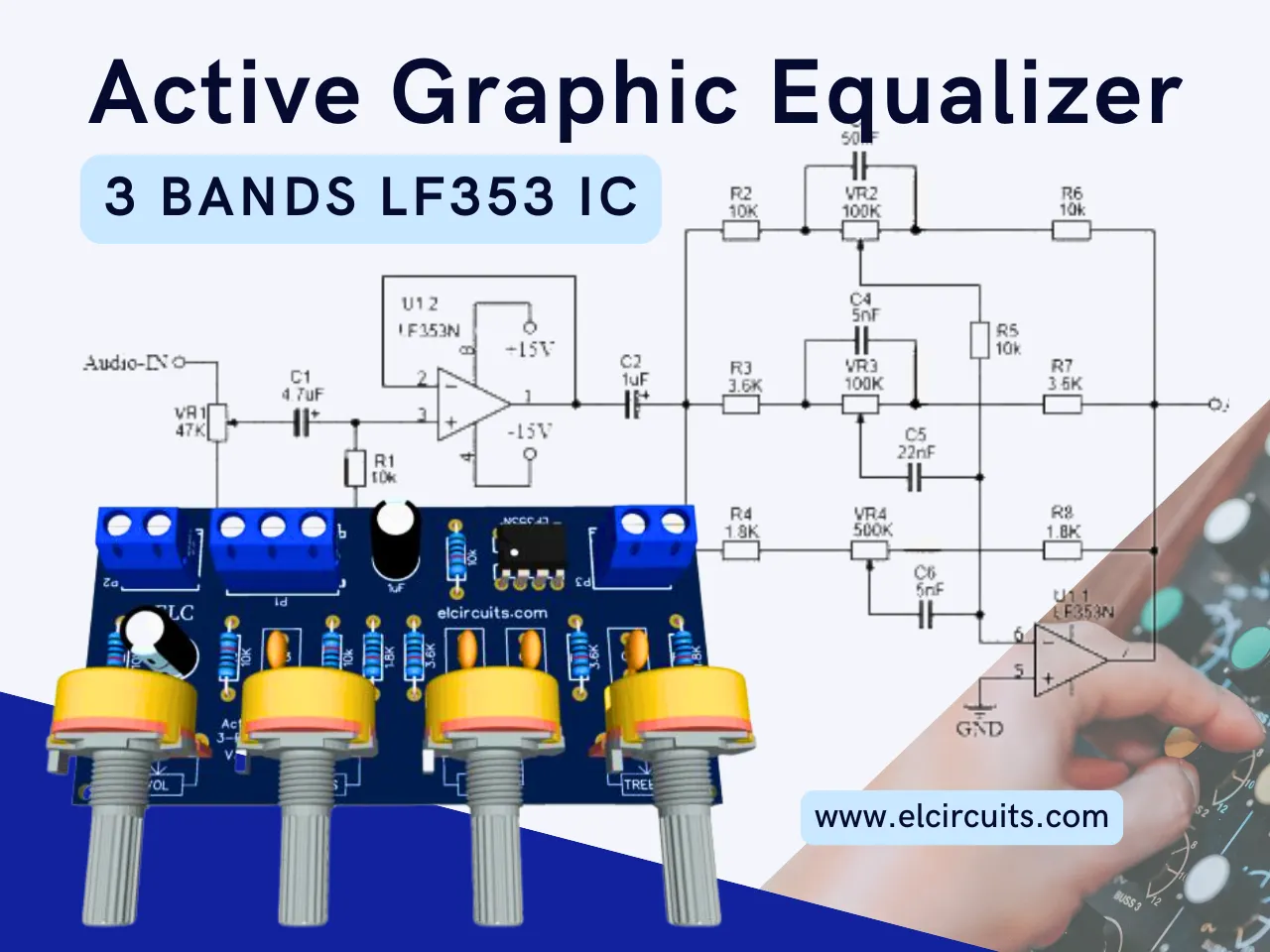
Hello, electronics enthusiast!
Today we’re going to dive into the fascinating world of audio processing with a project that will completely transform your sound experience: a 3-band active equalizer using the versatile LF353 IC. This circuit allows you to independently control the bass, mid, and treble frequencies, giving you total power over the sound of your audio system.
The LF353 is a high-performance operational amplifier with JFET (Junction Gate Field-Effect Transistor) inputs, designed to offer impressive bandwidth, extremely low input bias currents and internally compensated offset voltage. These characteristics make it perfect for high-fidelity audio applications, where signal purity is fundamental.
💡 Teacher’s Tip: The great advantage of operational amplifiers with JFET input, like the LF353, is its extremely high input impedance (10¹²Ω), which practically doesn’t “load” the previous circuit, preserving the integrity of the audio signal. Think of it as an extremely sensitive electronic “ear” that can capture all the details without interfering with the sound source!
⚙️ Technical Specifications of the LF353 IC
Before diving into the circuit, let’s understand why the LF353 is so special for audio applications:
- Internally Adjusted Offset Voltage: 10 mV
- Low Input Bias Current: 50pA
- Low Input Noise Voltage: 25 nV/√Hz
- Low Input Noise Current: 0.01 pA/√Hz
- Wide Gain Bandwidth: 4 MHz
- High Slew Rate: 13V/μs
- Low Supply Current: 3.6 mA
- High Input Impedance: 10¹²Ω
- Low Total Harmonic Distortion: ≤0.02%
- Low 1/f Noise: 50 Hz
- Fast Settling Time (0.01%): 2 μs
🎓 Deepening Knowledge: The slew rate of 13V/μs is particularly important for audio, as it determines how quickly the amplifier can respond to rapid changes in the signal. A higher rate means better ability to reproduce musical transients with precision, such as the attack of a cymbal or the “click” of an electric bass.
🛠️ How the Equalizer Circuit Works
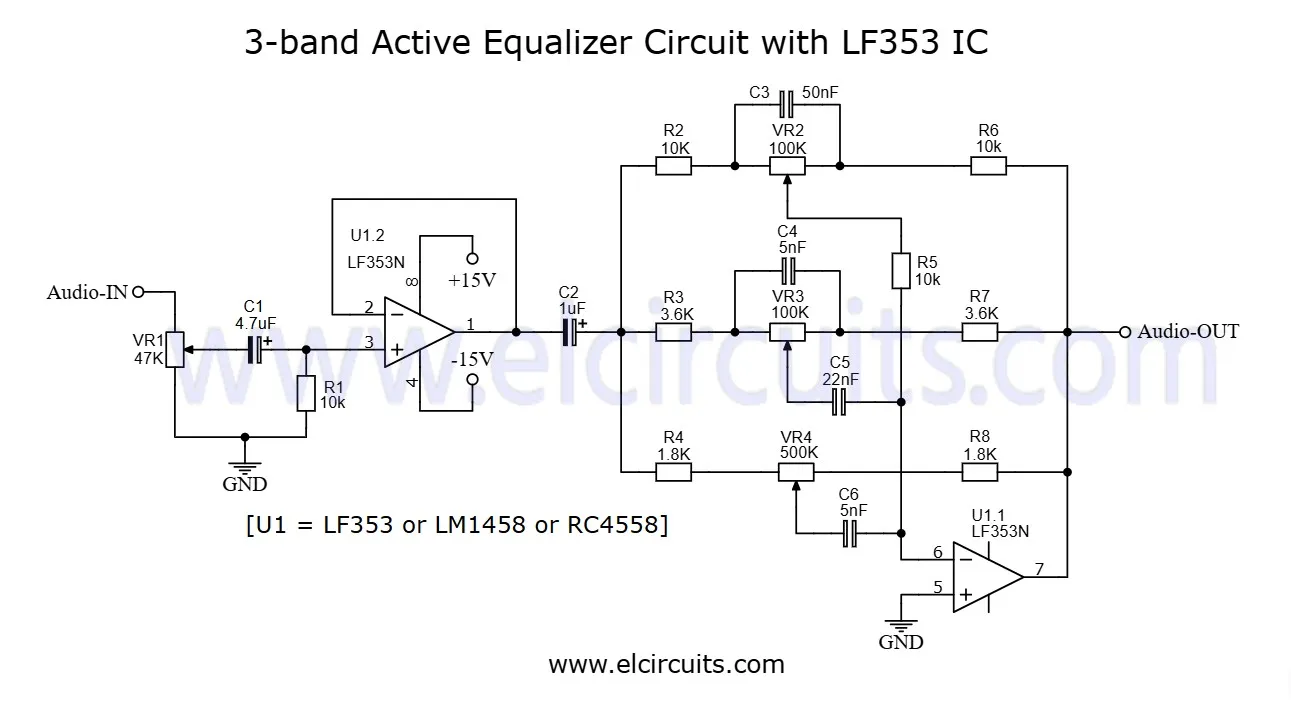
Our 3-band equalizer uses the LF353 IC to create active filters that allow independent control of frequencies. The magic lies in the capacitors, which determine the cutoff frequencies: the higher the capacitance, the lower the cutoff frequencies.
This project is a 2-octave graphic equalizer with 3 bands of control, with cutoff frequencies at: 150Hz, 1kHz, and 12kHz. These points were strategically chosen to cover the most important regions of the audible spectrum:
- 150Hz: Controls the fundamental bass, perfect for giving more “weight” to basses and drums
- 1kHz: Region of mid frequencies where the intelligibility of the human voice is concentrated
- 12kHz: Responsible for brightness and fine details, such as cymbals and harmonics
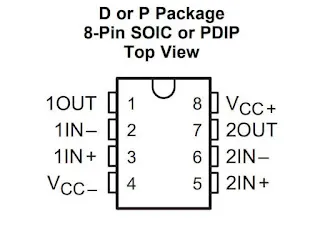
Although we designed this circuit with the LF353, you can replace it with other compatible ICs with the same pinout, such as: LM1558, RC4558, LM358, among others. However, remember that performance characteristics may vary, affecting the final audio quality.
The recommended supply voltage is between ±11V and ±15V, but the IC supports up to ±18V maximum. The current consumption of the IC is 6.5mA maximum and 3.6mA average, making it quite energy efficient.
🔧 Assembly Tip: The LF353 contains two internal amplifiers. In our circuit, we use one amplifier for each frequency range (bass, mid, and treble) and the last one for the final amplification of the entire circuit. This cascade configuration ensures a precise frequency response and minimal interference between bands.
🔌 Circuit Schematic
In Figure 3 below, we present the complete schematic of the 3-band equalizer circuit. You can download the project files in the downloads section at the end of this article.
💡 Ideas for Your Next Project
Did you like this project? Then you’ll love exploring other circuits we’ve prepared. Each one with its unique characteristics and ideal applications!
🛠️ Components List
To build your equalizer, you will need the following components:
- U1 .………………….. LF353 Integrated Circuit
- R1, R2, R5, R6 … 10K Resistor (brown, black, orange, gold)
- R3, R7 …………….. 3.6K Resistor (orange, blue, red, gold)
- R4, R8 …………….. 1.8K Resistor (brown, gray, red, gold)
- C1 …………………… 4.7uF Electrolytic Capacitor
- C2 …………………… 1uF Electrolytic Capacitor
- C3 …………………… 50nF Polyester Capacitor
- C4, C6 …………….. 5nF Polyester Capacitor
- C5 …………………… 22nF Polyester Capacitor
- VR1 …………………. 47K Potentiometer
- VR2, VR3 ………… 100K Potentiometer
- VR4 …………………. 500K Potentiometer
- P1 ……………………. 5mm 3-pin Screw Connector
- P2, P3 ………………. 5mm 2-pin Screw Connector
- Others ……………… PCB, solder, wires, etc.
🔍 Expert’s Tip: For best results, use metal film resistors (1% tolerance) and polyester or polypropylene capacitors with low tolerance. These higher quality components will ensure a more precise frequency response and less distortion in your equalizer.
🖨️ Printed Circuit Board (PCB)
To facilitate your assembly, we provide the files of the Printed Circuit Board (PCB) specifically designed for this equalizer. The PCB was carefully planned to minimize interference and ensure maximum signal quality.
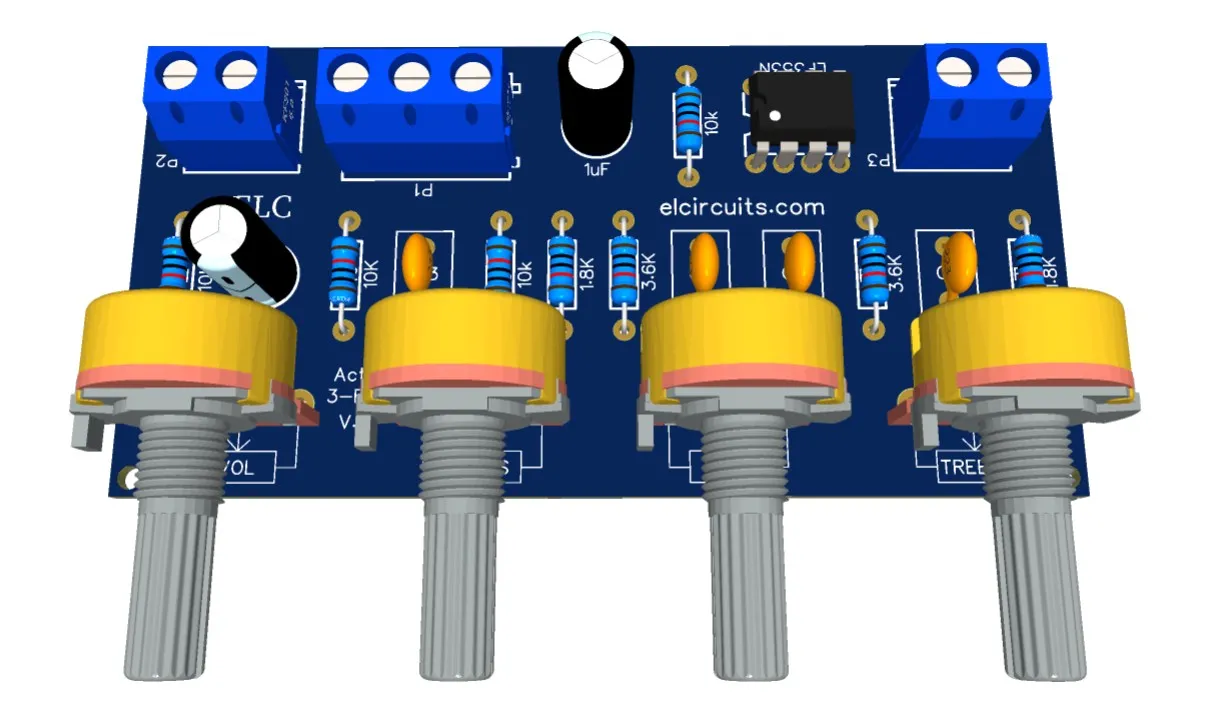
The files are available in GERBER, PDF, and PNG formats, covering all your needs, whether for a homemade assembly or to send to a professional fabrication. The PCB layout follows the best practices of audio circuit design, with properly sized traces and strategic component placement.
📥 Direct Download Link
To download the necessary files to build the electronic circuit, just click on the direct link provided below:
🔧 Assembly and Testing Guide
Now that you have all the components and the PCB, let’s go step by step of the assembly:
- Insert the smaller components: Start by soldering the resistors and diodes (if any). Check the orientation of polarized components.
- Soldering the capacitors: Install the polyester capacitors, paying attention to the polarity of the electrolytic capacitors.
- Install the potentiometers: Position the potentiometers as indicated in the layout. They should be mounted on the front of the panel for easy access.
- Install the LF353 IC: Use a socket for the IC, if possible. This facilitates replacement in case of failure and protects the IC during soldering.
- Power and signal connectors: Install the screw connectors for signal input/output and power supply.
- Visual inspection: Check all connections, possible short circuits or cold solders.
- Initial test: Connect a symmetrical power supply (±12V recommended) without input signal and check if there is no abnormal heating.
- Test with signal: Apply an audio signal and check the operation in all bands.
⚠️ Safety Alert: Always disconnect the power before handling the circuit. Use a symmetrical power supply with current limiting to protect the IC during initial tests. When soldering, work in a well-ventilated environment and use appropriate protective equipment.
🎵 Applications and Possibilities
Your new 3-band active equalizer can be used in various audio applications:
🎸 Musical Instruments
Perfect for customizing the tone of guitars, basses, and keyboards, adapting the sound to different musical styles.
🔊 Sound Systems
Ideal for correcting acoustic deficiencies in environments or adapting the frequency response of speakers.
🎧 Home Studios
Excellent for adjusting the sound during recordings or in the final mix, giving more control over the final result.
📡 PA Systems
Can be integrated into sound systems for environments, allowing fine adjustments in the frequency response.
💡 Teacher’s Tip: To experiment with the effects of the equalizer, try these initial settings: for powerful bass, increase the 150Hz control by +3dB; for more present vocals, slightly raise the 1kHz control (+2dB); and for more brightness and detail, increase the 12kHz control by +1.5dB. Remember that less is more – subtle adjustments usually produce more natural results!
🔧 Possible Improvements and Modifications
After building your basic equalizer, you can consider these improvements to take your project to the next level:
- Addition of LED indicators: Install LEDs to indicate the power status and signal activity.
- Bypass switches: Add switches to compare the sound with and without equalization.
- Integrated power supply: Develop a dedicated symmetrical supply for the equalizer.
- Expansion to 5 bands: Use the second channel of the LF353 or add another IC to create a 5-band equalizer.
- Protection circuits: Add overload protection at the output and additional filtering in the power supply.
🤔 Frequently Asked Questions (FAQ)
To ensure your project is a success, we’ve compiled some of the most common questions about this topic. Check it out!
Can I use other ICs besides the LF353 in this circuit? 🔽
Yes! You can replace the LF353 with other compatible ICs with the same pinout, such as LM1558, RC4558, or LM358. However, remember that performance characteristics may vary, affecting the final audio quality. The LF353 is particularly recommended for high-fidelity audio applications due to its low distortion and low noise.
What is the best power supply voltage for this equalizer? 🔽
The recommended supply voltage is between ±11V and ±15V. The IC supports up to ±18V maximum, but higher voltages may generate more heat without necessarily improving the audio quality. A symmetrical supply of ±12V is ideal for most applications, offering a good balance between performance and power consumption.
How can I expand this circuit to more frequency bands? 🔽
To expand to more bands, you’ll need more operational amplifiers. The LF353 already has two amplifiers, and we’ve used all of them in this 3-band project. You can add another LF353 or an IC with more channels (like the TL074, which has 4 amplifiers). Each additional band will need its own filter circuit and control potentiometer. The cutoff frequencies should be chosen to uniformly cover the audible spectrum.
Is it possible to add an overload protection circuit at the output? 🔽
Yes! You can add low-value resistors (10-47Ω) in series with the output for short-circuit protection. Another option is to implement a limiting circuit using diodes or a pair of transistors to detect over-current and reduce the gain when necessary. These protections are especially useful if the equalizer is used in professional applications where incorrect connections may occur.
🎓 Conclusion and Next Steps
Congratulations! You now have a high-quality 3-band active equalizer that will transform your audio experience. This project not only offers precise control over the sound, but also represents excellent learning about audio circuits and signal processing.
✨ Our Gratitude and Next Steps
We sincerely hope this guide has been useful and enriching for your projects! Thank you for dedicating your time to this content.
Your Feedback is Invaluable:
Have any questions, suggestions, or corrections? Feel free to share them in the comments below! Your contribution helps us refine this content for the entire ElCircuits community.
If you found this guide helpful, spread the knowledge!
🔗 Share This GuideBest regards,
The ElCircuits Team ⚡