Português
 Español
32W TDA2050 Hi-Fi Amplifier: Simple Single Power Supply + PCB


If you're looking for power and exceptional sound quality in an affordable project, this article is for you. Today we'll explore in detail the 32W Hi-Fi audio amplifier developed with the renowned TDA2050 IC from ST Microelectronics - a circuit that has become a reference among hobbyists and electronics professionals.
This project combines high-fidelity sound, low distortion levels, and simplified assembly, making it one of the most popular options for those who want to build a professional-quality audio system without spending a fortune. Get ready to dive into the world of high-quality audio amplification!
🔬 What is the TDA2050 and Why is it So Special?
The TDA2050 is a 32W monolithic class AB audio amplifier integrated circuit, available in the PentaWatt package. This component stands out for its ability to deliver significant power with minimal distortion, making it ideal for high-quality Hi-Fi projects.
Think of the TDA2050 as the heart of your audio system, just as a human heart efficiently pumps blood throughout the body, this IC pumps audio signals with clarity and precision to your speakers, ensuring an immersive sound experience faithful to the original recording.
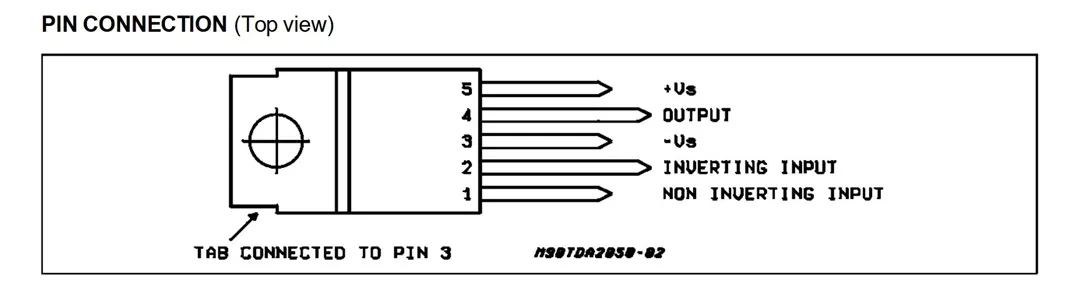
📌 Key Features of the TDA2050
The TDA2050 stands out in the market for several technical reasons that make it a superior choice for high-quality audio projects:
- High output power: Capable of delivering up to 32W RMS at 8 ohm load
- 50W Music Power: According to IEC 268.3 standards
- High operating voltage: Supports up to 50V power supply
- Power supply flexibility: Operates with single or split supply
- Extremely low harmonic distortion: THD of only 0.05% typical
- Short-circuit protection: Between output and ground
- Thermal protection: Automatic shutdown in case of overheating
But that's not all. What really sets the TDA2050 apart is its ability to maintain sound quality even at high volumes - something that many more expensive amplifiers cannot achieve.
🔧 Detailed Technical Specifications
For enthusiasts who love numbers, here are the technical specifications that make the TDA2050 stand out:- At 4 ohm load: Up to 35W @ THD = 10%, VS = ± 18V, f = 1KHz
- At 8 ohm load: Up to 32W @ THD = 10%, VS = ± 22V, f = 1KHz
- At 4 ohm load (peak): Up to 50W for 1 second at VS = 22.5V, f = 1KHz
- Harmonic distortion: THD = 0.05% typical @ VS = ± 22V, PO = 0.1 to 15W, RL = 8ohm, f = 100Hz to 15KHz
These numbers translate into crystal-clear audio, with deep bass, crisp trebles, and mids that preserve all the details of the original recording - exactly what we expect from a high-quality Hi-Fi system.
🔌 Circuit Schematic Diagram!
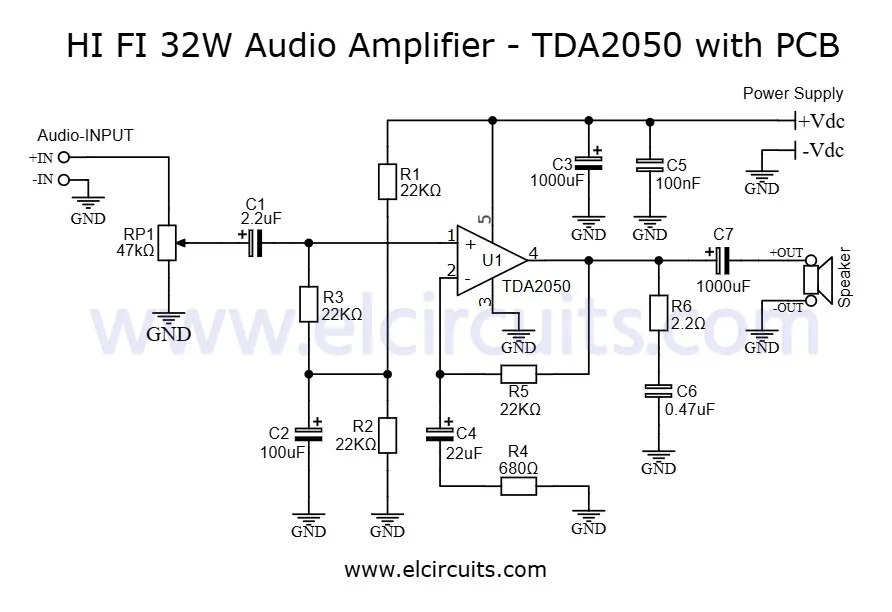
In Figure 2 below, we present a diagram of the 32W HI-FI Sound Amplifier circuit with TDA2050 for clear visualization of the connection between components.
For a complete stereo system, simply assemble two identical circuits, one for each channel (left and right). This modular approach offers flexibility and facilitates system maintenance.
💡 Ideas for Your Next Project
Did you like this project? Then you'll love exploring other circuits we've prepared. Each with its own characteristics and ideal applications!
- 170W AB Class Bridge Mode Amplifier using TDA7294 IC + PCB
- High Fidelity 14W - 12V Power Amplifier using TDA2030 IC + PCB
- 24W Stereo Hi-Fi Audio Amplifier using TDA2616 + PCB
- 4 x 50W High Power Amplifier, 14.4V - IC TDA7563A + PCB
- 70W Stereo HI-FI Power Amplifier - High Fidelity with two TDA2050 + PCB
- 56W RMS Hi-FI Amplifier with LM3875 Integrated Circuit + PCB
- HI-FI 30W Audio Power Amplifier With IC LM1875 + PCB
- 5W BTL Audio Amplifier with DC volume control + PCB
- HI FI 32W Audio Amplifier - TDA2050 - Simple PS + PCB
- 180W RMS 4-Channel Amplifier with TDA7386 + PCB
- 100W RMS Audio Amplifier IC TDA7294 + PCB
🛠️ Component List
Here is the complete list of components you will need to assemble this amplifier. I recommend using exactly the specified values to ensure the best possible performance:
| Component | Specification |
|---|---|
| U1 | TDA2050 Integrated Circuit |
| R1, R2, R3, R5 | 22KΩ 1/4W Resistor |
| R4 | 680Ω 1/4W Resistor |
| R6 | 2.2Ω 1/4W Resistor |
| C1 | 2.2uF / 25V Electrolytic Capacitor |
| C2 | 100uF / 25V Electrolytic Capacitor |
| C3, C7 | 1000uF / 50V Electrolytic Capacitor |
| C4 | 22uF / 25V Electrolytic Capacitor |
| C5 | 100nF Polyester Capacitor |
| C6 | 0.47uF Polyester Capacitor |
| RP1 | 47KΩ Potentiometer |
| P1, P2, P3 | Screw Terminal Block: 2 pins, 5 mm |
| Miscellaneous | Heat sink, screws, solder, etc. |
🖨️ Printed Circuit Board (PCB)
To facilitate your assembly, we provide the files of the Printed Circuit Board (PCB) specifically designed for this equalizer. The PCB was carefully planned to minimize interference and ensure maximum signal quality.
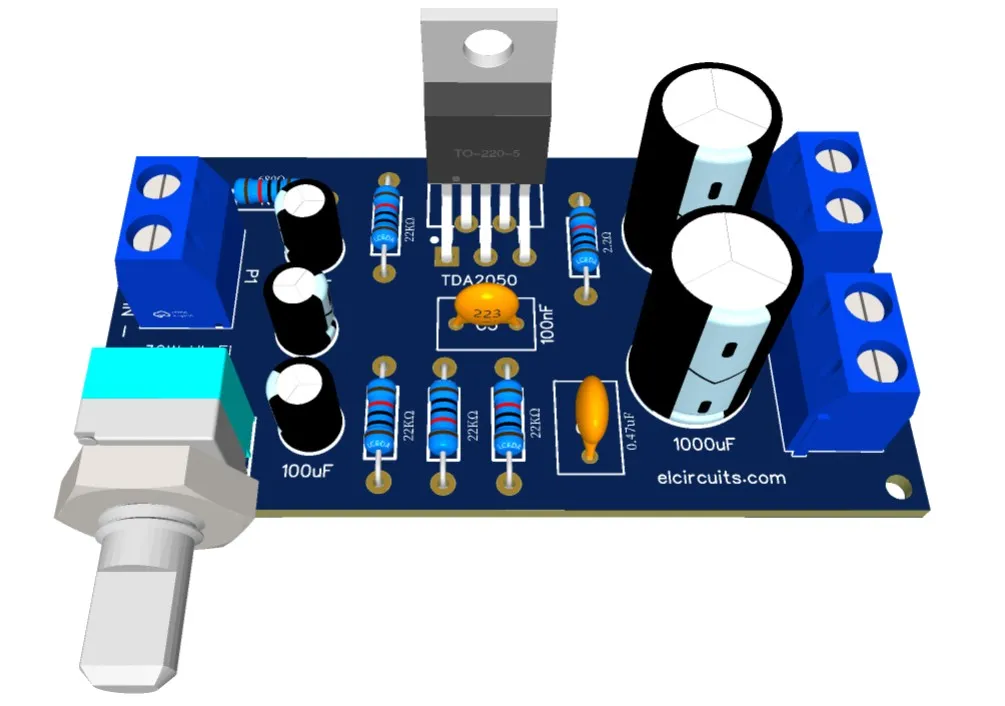
The files are available in GERBER, PDF, and PNG formats, covering all your needs, whether for home assembly or for sending to professional manufacturing. The PCB layout follows the best practices of audio circuit design, with properly sized traces and strategic component placement.
📥 Direct Download Link
To download the necessary files to assemble the electronic circuit, simply click on the direct link provided below:
🤔 Frequently Asked Questions (FAQ)
To ensure your project is a success, we've compiled some of the most common questions about this amplifier. Check them out!
What is the best power supply for this amplifier? 🔽
For optimal performance, a symmetrical power supply of ±18V to ±22V with a capacity of at least 2A is recommended. A well-filtered and stabilized supply will ensure less noise and better sound quality. You can use transformers with double secondary (12V+12V or 15V+15V) followed by a bridge rectifier and appropriate filter capacitors.
Can I use this amplifier with 4-ohm speakers? 🔽
Yes, the TDA2050 can operate with 4-ohm speakers, but this will require a larger heat sink as the IC will heat up more. With 4 ohms, you'll get more power (up to 35W), but also higher current consumption and heat. Make sure your power supply can provide sufficient current and that the heat sink is adequate for this configuration.
How to assemble a complete stereo system with this circuit? 🔽
To create a stereo system, you'll need to assemble two identical circuits - one for the left channel and one for the right. Both can be powered by the same symmetrical supply, as long as it has sufficient capacity (at least 4A). You can use a dual stereo potentiometer to control the volume of both channels simultaneously, or two individual potentiometers for separate control.
What is the ideal size of the heat sink for the TDA2050? 🔽
For operation with 8 ohms, a heat sink with thermal resistance of approximately 4°C/W is sufficient. If you plan to use 4 ohms or operate at high volumes for long periods, a larger heat sink with thermal resistance of 2°C/W or lower is recommended. Remember to use thermal paste between the IC and the heat sink to ensure efficient heat transfer.
🎓 Conclusion: Your Next Step in the High-Quality Audio Journey
The TDA2050 amplifier represents the perfect balance between simplicity, cost, and performance. With this project, you'll have an audio system capable of reproducing music with the clarity and fidelity that audiophiles demand, without the complexity and cost of more elaborate systems.
If you've already assembled this amplifier, share your experience in the comments below! We'd love to see photos of your project and hear your impressions about the sound quality. And if you still have questions, don't hesitate to ask, our community is here to help!
Ready to elevate your audio experience? Download the PCB files, gather your components, and start assembling your 32W Hi-Fi amplifier today. The amazing sound you'll get will be the reward for your work!
✨ Our Gratitude and Next Steps
We sincerely hope this guide has been useful and enriching for your projects! Thank you for dedicating your time to this content.
Your Feedback is Invaluable:
Have any questions, suggestions, or corrections? Feel free to share them in the comments below! Your contribution helps us refine this content for the entire ElCircuits community.
If you found this guide helpful, spread the knowledge!
🔗 Share This GuideBest regards,
The ElCircuits Team ⚡