Português
 Español
440W Class-AB Mosfet Power Amplifier with IRFP9240 / IRFP240 + PCB

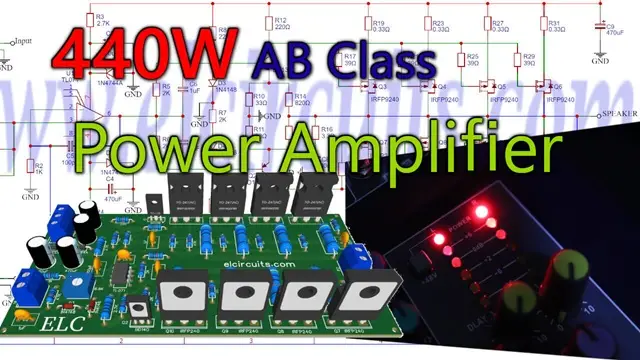
This is a high performance power amplifier, which despite its simplicity in construction, in tests performed, it presented parameters with great results, very close to what we call a HI-FI amplifier.
🔌 The Circuit Works
The complexity of the circuit is at an advanced level, it is not recommended for those who don’t have experience in electronics and in assembling amplifier circuits, you must have minimal knowledge at an advanced level to assemble this type of power amplifier.
The circuit diagram of the power amplifier is shown in Figure 2 below. It uses 8 output Mosfet power transistors, 4 transistors for the positive cycle and 4 transistors for the negative cycle.

Fig. 2 – Schematic diagram 440W Class AB Power Amplifier using Mosfet IRFP9240 and IRFP240 Transistors
The input circuit consists of a TL431 Op-Amp, it is used as a feed-forward preamplifier for driver circuit units that produce a primary voltage gain at the output stage.
The circuit is divided into 2 identical half-cycles: one side for the positive half-wave of the signal fed through driver transistor Q1 NPN BD139, which feeds the output transistors (Q3, Q5, Q7, Q9) P-Channel IRFP9240, other side for the negative half-wave of the signal fed through driver transistor Q2 PNP BD140, which feeds the output transistors (Q4, Q6, Q8, Q10) N-Channel IRFP240.
You might also be interested in:
- Build a 50W RMS Audio Amplifier with Mosfet | Complete DIY Guide
- 160W High Fidelity Amplifier using Mosfet 2SK1058 and 2SJ162 with PCB
- 400W Class AB Amplifier using MJL4281A and MJL4302A transistors + PCB
- 200W RMS Power Amplifier With 2SC2500 AND 2SA1943 + PCB
- 300W RMS Power Amplifier – 2SC3858 and 2SA1494 Transistors + PCB
- 50W RMS Audio Amplifier with IRF530 and IRF9530 Mosfet + PCB
- 100W RMS Power Amplifier With 2 NPN 2SC5200 Transistors At Output + PCB
- Simple 3 Transistors Power Amplifier push a 600W RMS Subwoofer + PCB
⚡The Power Supply
The power supply is of the symmetrical type, with a supply voltage of +55V | 0V | -55V, with a current of 10 Amperes, with good filtering.
In Figure 3 below, we have a suggestion for a power supply that we use in our projects. In this article, besides having the schematic diagram with the Printed Circuit Board, you will understand how to easily calculate your own Power Supply, with the desired voltage.
You can in the link below:

Fig. 3 – Symmetrical Power Supply for Power Amplifiers
🧾 Components List
- Semiconductors
- U1 …………………….. TL071 Integrated Circuit
- Q1 …………………….. BD139 NPN Transistor
- Q2 …………………….. BD140 PNP Transistor
- Q3, Q4, Q5, Q6 ….. IRFP9240 Mosfet Transistor
- Q7, Q8, Q9, Q10 … IRFP240 Mosfet Transistor
- D1, D2 ………………. 1N4744 15V Zener diode
- D3, D4 ………………. 1N4148 diode
- Resistor
- R1, R33 …………….. 47KΩ (yellow, violet, orange, gold)
- R2 …………………….. 1KΩ (brown, black, red, gold)
- R3, R4 ……………….. 2K7Ω (red, violet, red, gold)
- R5, R6 ……………….. 2KΩ (red, black, red, gold)
- R7 ……………………… 6k8Ω Trimpot
- R8, R9 ……………….. 22KΩ (red, red, orange, gold)
- R10, R11 ……………. 33Ω (orange, orange, black, gold)
- R12, R13 ……………. 220Ω (red, red, brown, gold)
- R14, R5 ……………… 820Ω (grey, red, brown, gold)
- R16 ……………………. 3.3Ω (orange, orange, gold)
- R17, R18, R21, R22, R25, R26, R29, R30 …. 39Ω (orange, white, black, gold)
- Capacitor
- C1, C5 ……………….. 100pF Ceramic Capacitor
- C2, C6, C7 ………….. 1uF Ceramic Capacitor
- C3, C4, C9, C10 ….. 470uF / 65V Electrolytic Capacitor
- C8 ……………………… 100nF Ceramic Capacitor
- Miscellaneous
- P1 ………. 2-pin PCB soldering terminal blocks
- P2 ………. 3-pin PCB soldering terminal blocks
- Others …. Printed Circuit Board, heat sink, wires, etc.
🖨️ Printed Circuit Board – Download
We are offering PCB – Printed Circuit Board, in GERBER, PDF and PNG files, for you who want to do the most optimized assembly, either at home.
If you prefer in a company that develops the board, you can is downloading and make the files in the Download option below.

Fig. 3 – 440W Class AB Power Amplifier using Mosfet IRFP9240 and IRFP240 Transistors
Files to Download, Direct Link:
✨ Our Gratitude and Next Steps
We sincerely hope this guide has been useful and enriching for your
projects! Thank you for dedicating your time to this content.
Your Feedback is Invaluable:
Have any questions, suggestions, or corrections? Feel free to share them
in the comments below! Your contribution helps us refine this
content for the entire ElCircuits community.
If you found this guide helpful, spread the knowledge!
Best regards,
The ElCircuits Team ⚡